
Summary
- Quantitative Chemistry studies amounts, masses and chemical calculations
- GCSE quantitative Chemistry includes equations, ratios and concentration calculations
- Students need to understand formulas instead of memorising steps blindly
- Mole calculations and balanced equations are very important in exams
- Regular practise helps students solve quantitative Chemistry GCSE questions more easily
- Many students lose marks from simple calculation and unit mistakes
- Clear methods and steady revision can improve confidence and exam results
What Is Quantitative Chemistry?
Quantitative Chemistry is the study of amounts in chemical reactions. It looks at how much of a substance you use or produce. In this topic, you will work with Maths, simple formulas and basic equations to find these amounts.
Many students ask what quantitative Chemistry is, because it feels new at first. But the main idea is simple and easy to follow. You learn how to measure and calculate amounts in a clear, step-by-step way. With a bit of practise, most students find they grow more confident with it over time.
GCSE Quantitative Chemistry topics often include:
- Relative formula mass
- Moles
- Balanced equations
- Concentration calculations
- Percentage yield
- Atom economy
These topics help students understand how chemical reactions work in real situations. Students can also check the official AQA GCSE Chemistry specification and Edexcel GCSE Chemistry course page to see the full list of topics and exam content.
Why Quantitative Chemistry Matters in GCSE Chemistry
Quantitative Chemistry is a big part of GCSE Chemistry. Many exam tasks use Maths and equations. You need both Maths skills and Science knowledge. This topic helps you solve problems step by step. It also helps you check your work with care. Many students find it hard at first, but practise makes it easy. You will understand the Maths better and feel sure of yourself. Steady revision is the best way to get great marks.
Understanding Quantitative Analysis in Chemistry
Many students ask what quantitative analysis means in Chemistry. It measures how much of a substance is in a sample. Scientists use these methods in experiments. They collect clear data from tests. This helps them stay accurate. It also helps them reach reliable results.
Quantitative analysis Chemistry often focuses on:
- Measuring mass
- Measuring concentration
- Calculating yields
- Comparing results
- Analysing chemical reactions
In GCSE Chemistry, students mainly use simple calculations and equations during quantitative chemical analysis questions.
Key Quantitative Chemistry GCSE Topics
1. Relative Formula Mass
Relative formula mass is the total mass of all atoms in a compound. Find the mass of each atom, then add them all up using the periodic table.
This is a key skill for GCSE quantitative Chemistry. It helps you solve many exam questions and is a great place to start your revision.
For example:
- H₂O = 18
- CO₂ = 44
- NaCl = 58.5
This topic forms the foundation for many later calculations in quantitative Chemistry GCSE questions.
2. The Mole
The mole is a key idea in quantitative Chemistry. One mole is a set amount of tiny particles.
Many students find moles tricky at first, as the concept is hard to picture. But the sums get easier with practise. Master this topic and you will be ready for tough exam questions.
Students often use this equation:
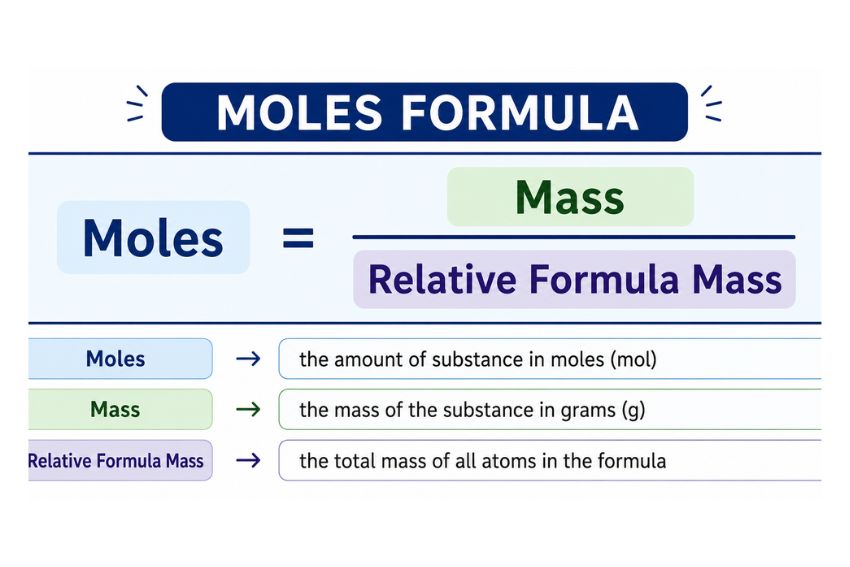
The moles formula appears frequently in quantitative Chemistry GCSE equations and exam questions.
3. Balanced Chemical Equations
Balanced equations show the right ratio between reactants and products. Because of this, always balance your equations before starting any mole sums.
This is a vital step in Quantitative Chemistry. As a result, it makes solving GCSE equations much easier. In turn, you will feel more prepared when answering exam questions.
For example:
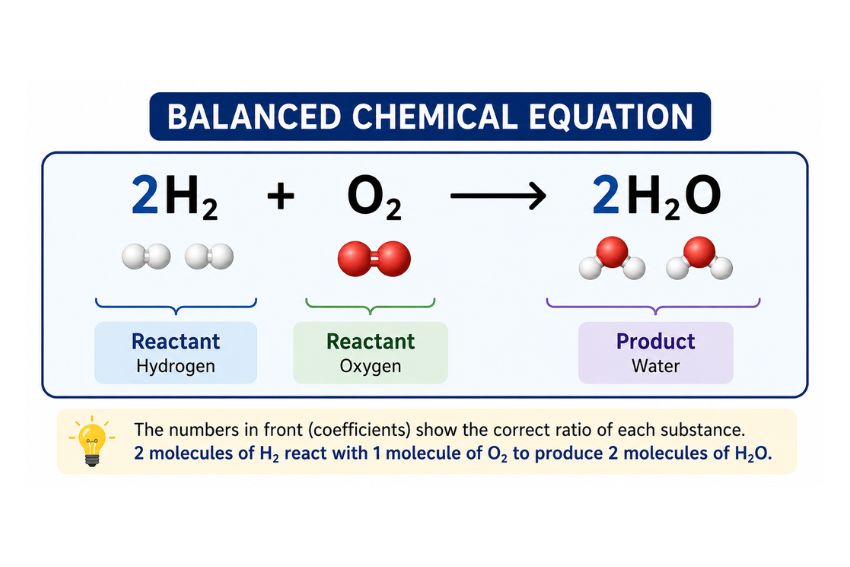
Balanced equations are very important because incorrect ratios lead to incorrect answers later.
4. Concentration Calculations
Concentration shows how much solute is in a liquid. Because of this, it is a key part of GCSE Quantitative Chemistry.
To find it, first check the mass and volume. Then, use these to calculate the answer. As a result, with regular practise, you will solve these sums fast in exams.
A common formula is:
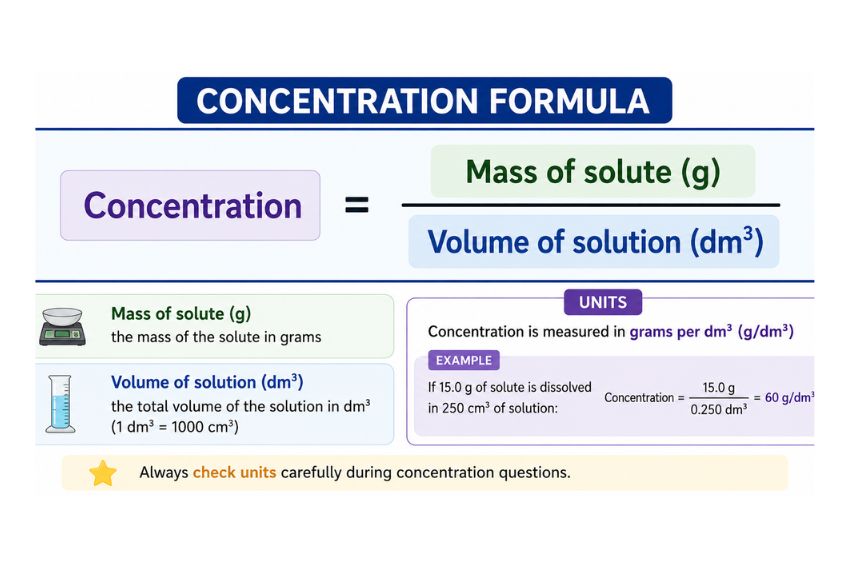
Students should always check units carefully during these questions.
5. Percentage Yield
Percentage yield shows how much you make in a reaction compared to how much you should make. Because of this, it tells you how well a process works.
First, find the mass you expect. Then, measure the real mass you made. After that, use a simple formula to find the percentage.
This is a key skill in Quantitative Chemistry. Therefore, practise these steps often to get the best results in your exams.
Students use this equation:
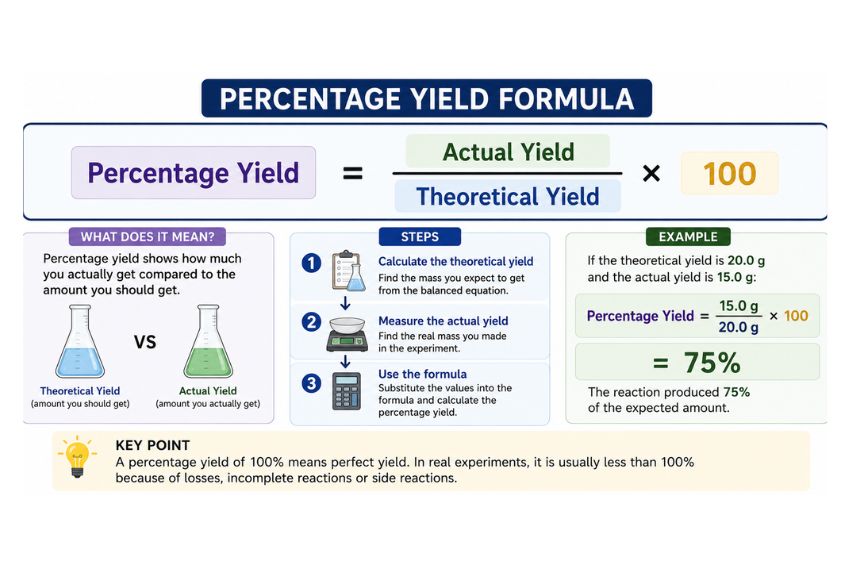
This topic helps students understand why reactions do not always produce perfect results.
Common Mistakes in Quantitative Chemistry
Many students make the same errors during their Quantitative Chemistry revision. For example, they might forget to use the right units in their sums. Students who find these slips early on tend to improve much faster. Therefore, you should check your work as you go.
Spotting these habits is a big part of what is Quantitative Chemistry. If you catch your mistakes, you will find it easier to solve Quantitative Chemistry GCSE questions. You should also use your Quantitative Chemistry GCSE equations to check your answers. As a result, you will feel more sure of yourself during your exams. Over time, this leads to better grades in Quantitative Analysis Chemistry.
1. Forgetting Units
Many students get the right answer but forget the units. This often leads to lost marks in the exam. Therefore, you must always check your units in Quantitative Chemistry GCSE questions.
Students should always check:
- grams
- cm³
- dm³
- mol
2. Using the Wrong Formula
Many Quantitative Chemistry GCSE equations look very similar. Because of this, some students pick the wrong way to solve a sum. Therefore, you should take your time to read each task with care.
Learning the right formulas is a big part of what is Quantitative Chemistry. If you know the methods well, you will find it easier to answer your Quantitative Chemistry GCSE questions. As a result, you will feel more sure of yourself during the exam.
Practise your quantitative analysis skills often to avoid these slips. This will help you get the best marks in your GCSE Chemistry papers. Regular practise helps you see which formula fits each question.
3. Skipping Working Out
Some students try to do sums in their head. This makes it easy to make a mistake. Therefore, you should always write down each step of your work.
Showing your steps is vital for Quantitative Chemistry GCSE questions. It helps you stay clear. It also helps you avoid small errors. As a result, you can use your Quantitative Chemistry GCSE equations with more ease. This is a big part of good quantitative analysis in your exams. You should use a pen and paper for every task you try.
4. Not Balancing Equations
Wrong balancing causes many mole errors. Therefore, you should always balance your equations first. You must do this before you start to find the ratios between substances.
This is a key step in Quantitative Chemistry. It helps you get the right answer for your Quantitative Chemistry GCSE questions and sums. As a result, you will find it much easier to use your Quantitative Chemistry GCSE equations. Taking the time to check your work will help you do well in Quantitative Analysis Chemistry.
Best Revision Tips for Quantitative Chemistry
Good plans help you grow fast. So, try to keep your work neat and steady. A clear plan makes it easy to stay on track. In turn, you will find it much easier to hit your goals. As a result, small steps each day will lead to big wins in your exams.
Practise Calculations Daily
Short daily sessions work better than one long session a week. As a result, formulas will stick much faster.
Learn the Meaning Behind Equations
Understand why formulas work, not just how. This way, you can solve problems with more confidence in exams.
Use Past GCSE Questions Regularly
Past papers help you spot patterns. Therefore, use them often to get comfortable with exam wording and methods.
Check Every Step Carefully
Many marks are lost on small slips. So always check your units, decimal points and calculator entries before moving on.
Why Students Find Quantitative Chemistry Difficult
Quantitative Chemistry mixes Science and Maths. So, some students feel stressed at first. However, take it one step at a time. In turn, you will get used to the sums and equations. As a result, practise will make you feel much more sure of yourself.
Many students struggle because:
- equations feel confusing
- calculations contain several steps
- units can change during questions
- mistakes affect later answers
However, steady practise usually solves these problems over time. Most students improve once they learn clear calculation methods.
How to Improve in Quantitative Chemistry
Top students use simple habits and not hard plans. Therefore, keep your study time easy and clear.
This helps you with quantitative Chemistry GCSE questions. As a result, you will find it easy to use your quantitative Chemistry GCSE equations. This is the best way to get better at quantitative analysis. Stick to small steps to see big results.
Good revision habits include:
- practising little and often
- reviewing mistakes carefully
- learning formulas step by step
- completing past paper questions
- checking mark schemes regularly
Over time, these habits help students feel calmer and more confident in exams.
Conclusion
Quantitative Chemistry is a key GCSE topic. It teaches you how to measure reactions. At first, the tasks may feel hard. However, regular practise helps you get better over time.
Mole sums and equations become easier when you do them often. You should focus on how methods work and not just learn them by heart. In addition, using Quantitative Chemistry GCSE equations often helps you feel ready for exams.
As a result, you will find it easier to solve Quantitative Chemistry GCSE questions. This steady work is the best way to get better at quantitative analysis. With practise and the help of a qualified GCSE Chemistry tutor, you can build skill and get great marks in your Chemistry course.
You Might Be Interested In
GCSE Chemistry Topics: Full List for Every Exam Board
GCSE Chemistry – Atomic Structure
Group 0 Elements: A Complete GCSE Chemistry Guide to Noble Gases
GCSE Chemistry – Bonding, Structure and the Properties of Matter
FAQs
What is quantitative Chemistry?
Quantitative Chemistry studies amounts and measurements in chemical reactions. It focuses on calculations involving mass, moles, concentration and chemical equations.
Why is quantitative Chemistry important in GCSE Chemistry?
Quantitative Chemistry is important because many GCSE Chemistry exam questions include calculations and equations. Students need these skills to solve problems correctly and gain marks in exams.
What are the hardest parts of quantitative Chemistry GCSE?
Mole calculations and balanced equations are often the hardest parts for students. Many students also struggle with units and multi-step calculations at first.
How can students improve in quantitative Chemistry?
Students can improve by practising calculations regularly and checking mistakes carefully. In addition, using past paper questions helps students understand common exam methods and question styles.