

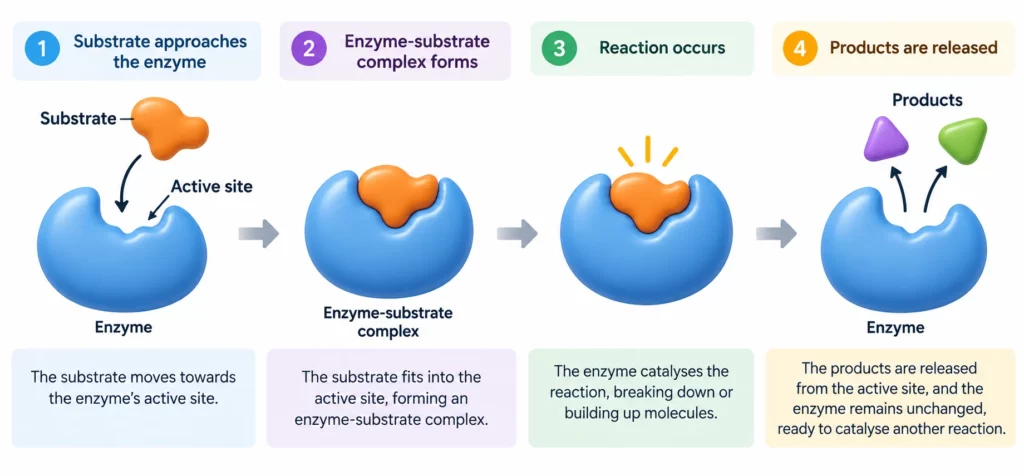
The lock and key theory explains how enzymes bind to specific substrates. Each enzyme has an active site with a particular shape. A substrate with a complementary shape fits into this active site, forming an enzyme-substrate complex. The enzyme then speeds up the reaction, releases the products and can be used again.
For GCSE Biology, you should understand the lock and key model, why enzymes are specific and how factors such as temperature, pH and substrate concentration affect enzyme activity. In addition, these ideas help explain how enzymes respond to changing conditions.
This article explains each step with examples and diagrams to help you revise the topic for your GCSE Biology exam.
What Are Enzymes?
Enzymes are proteins that speed up chemical reactions in living organisms. Without them, many processes in the body would happen too slowly to sustain life. For a wider look at how organs and organ systems work together, see our GCSE Biology Organisation guide.
Since they are biological catalysts, they help reactions occur faster without being used up or changed in the process. Therefore, scientists often explain how they work using the lock and key model, which shows how specific each enzyme is to its job.
Enzymes are one part of the wider GCSE Biology syllabus. For more on how cells work, see our GCSE Cell Biology guide.
How Do Enzymes Work in The Lock and Key Model?
Each enzyme has a specific shape, which includes an active site. This is where the substrate (the molecule the enzyme acts on) binds. In the lock and key model, the substrate fits into the active site in the same way a key fits a particular lock. Afterwards, the enzyme releases the products and is free to work again.
Why Are Enzymes Important?
Enzymes are involved in many essential processes in the body, such as:
Digestion – Breaking down food into smaller molecules for absorption.
Metabolism – Speeding up reactions that provide energy.
DNA Replication – Helping cells copy genetic material.
Since enzymes are so important, their function needs to be well-regulated. Next, we’ll explore how the Lock and Key Theory explains enzyme specificity!
What Is the Lock and Key Theory?
The lock and key theory explains how enzymes bind to specific substrates. Each enzyme has an active site with a particular shape. A substrate with a complementary shape can fit into this active site, much like a key fits into a lock.
How Does the Lock and Key Model Work?
- The substrate approaches the enzyme.
- The substrate fits into the enzyme’s active site.
- An enzyme-substrate complex forms.
- The enzyme catalyses the reaction, breaking down or building molecules.
- The products are released from the active site.
- The enzyme remains unchanged and can be used again.
The lock and key model helps explain enzyme specificity. Only substrates with a complementary shape can bind effectively to an enzyme’s active site. This allows enzymes to catalyse particular biological reactions.
Factors That Affect Enzyme Activity in GCSE Biology
Enzymes don’t work at the same speed all the time. Several factors can increase or decrease their activity, affecting how well they function. Let’s look at the three main factors: temperature, pH, and substrate concentration.
1. Temperature
Temperature affects enzyme activity by changing how quickly molecules move. As temperature rises, enzyme and substrate molecules gain kinetic energy. They collide more often, so more enzyme-substrate complexes form and the reaction rate increases.
This continues until the enzyme reaches its optimum temperature. However, above this temperature, bonds within the enzyme begin to break. The active site changes shape, so the substrate can no longer fit properly. As a result, the enzyme becomes denatured and the reaction rate falls sharply.
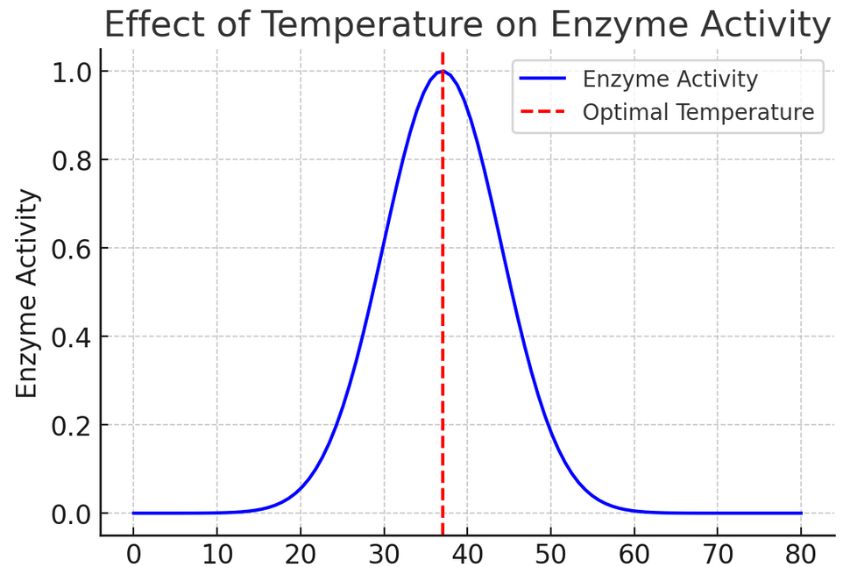
Temperature and enzyme activity graph: Enzyme activity increases up to the optimum temperature before falling rapidly as the enzyme denatures.
2. pH
Each enzyme works best within a particular pH range. This is known as its optimum pH. Moving away from the optimum can change the bonds that maintain the enzyme’s shape.
If the pH becomes too high or too low, the shape of the active site may change. The substrate may no longer fit correctly, so fewer enzyme-substrate complexes form and enzyme activity decreases. At extreme pH levels, the enzyme can become denatured.
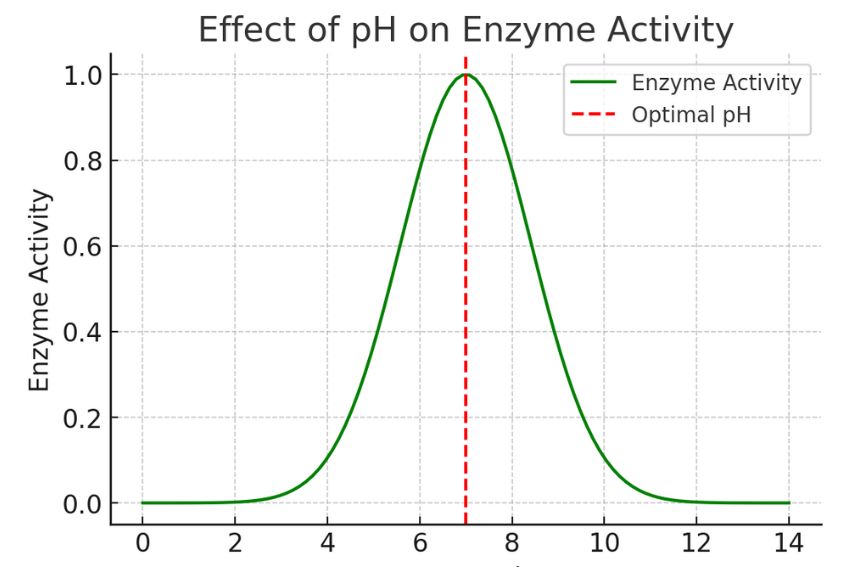
pH and enzyme activity graph: Enzyme activity is highest at the optimum pH and decreases as conditions move further away from it.
3. Effect of Substrate Concentration on Enzyme Activity
Substrate concentration affects how quickly an enzyme-controlled reaction takes place. When substrate concentration increases, more substrate molecules are available to collide with enzyme active sites. This means more enzyme-substrate complexes can form, so the reaction rate increases.
However, the rate does not keep increasing forever. At high substrate concentrations, all available enzyme active sites become occupied. The enzymes are working at their maximum rate, so adding more substrate has little or no further effect.
Why Does the Reaction Rate Level Off?
The reaction rate eventually reaches a maximum because enzyme concentration becomes the limiting factor. Once all active sites are occupied, there are no extra enzymes available to bind with the additional substrate.
At this point:
- all enzyme active sites are being used
- increasing substrate concentration no longer increases the reaction rate
- adding more enzyme would be needed to increase the rate further
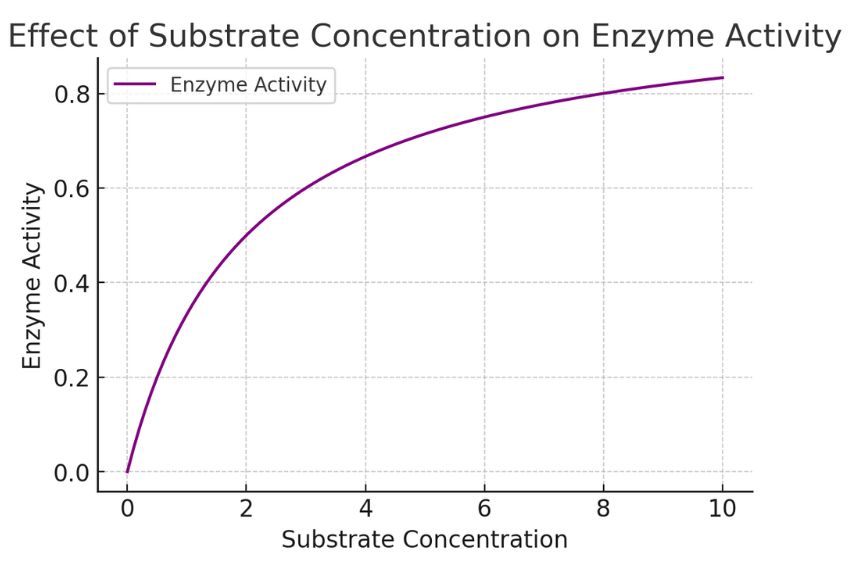
The graph rises steeply at first because increasing substrate concentration leads to more successful collisions between substrates and enzyme active sites. It then levels off once the enzymes become saturated and cannot work any faster.
Understanding how temperature, pH and substrate concentration affect enzymes is an important part of GCSE Biology. These factors are often tested through graph interpretation and exam-style questions.
If your child finds enzyme questions difficult, Biology tutoring can provide personalised one-to-one support with enzyme activity, GCSE Biology topics and exam technique.
Lock and Key Theory GCSE Exam Questions
The lock and key theory is often tested in GCSE Biology through questions about enzyme specificity, active sites and enzyme-controlled reactions. Students may also need to explain how temperature, pH and substrate concentration affect enzyme activity or interpret graphs showing changes in reaction rate.
You may be asked to:
- define an enzyme and substrate
- identify the active site of an enzyme
- explain why enzymes are specific
- describe how an enzyme-substrate complex forms
- explain how temperature or pH affects enzyme activity
- explain the effect of substrate concentration on reaction rate
- interpret an enzyme activity graph
Example GCSE Question
Explain why an enzyme only works with a particular substrate.
Model answer:
An enzyme has an active site with a specific shape. Only a substrate with a complementary shape can fit into the active site. When the substrate binds, an enzyme-substrate complex forms and the enzyme can catalyse the reaction.
Common Exam Mistake
Avoid saying that the substrate and active site have “the same shape”. A stronger GCSE Biology answer is that the substrate has a complementary shape to the enzyme’s active site.
Also avoid saying that the enzyme is used up during the reaction. Enzymes remain unchanged after the products are released, which means they can be used again.
This section works well because it adds a new layer of intent without repeating the earlier explanation: definition → mechanism → factors → exam application.
If your child needs support with Biology or another Subject, you can explore our online tutors for personalised one-to-one lessons. Meet some of our Biology tutors who can help students strengthen their understanding of enzymes, exam technique and other GCSE Biology topics.

Oscar H.
Biology | Geography | Maths Tutor
Student at University of Warwick
£57 / session
Book a free trial
Chinmoy S.
Science | Physics | Biology Tutor
Student at University College London (UCL)
£54 / session
Book a free trialLock and Key Model vs Induced Fit Model
The lock and key model is a simple way to explain enzyme specificity. It suggests that the enzyme’s active site has a fixed shape and only a substrate with a complementary shape can fit into it.
The induced fit model gives a more detailed explanation. In this model, the active site changes shape slightly when the substrate binds. This helps the enzyme fit the substrate more closely and carry out the reaction.
For GCSE Biology, the lock and key model is commonly used to explain enzyme action, while the induced fit model provides a more accurate description of how some enzymes work.
| Lock and Key Model | Induced Fit Model |
| Active site is treated as a fixed shape | Active site changes shape slightly |
| Substrate fits the active site | Binding causes a closer fit |
| Simple model of enzyme specificity | More detailed explanation of enzyme action |
Key and Lock Theory – Further Resources
If you want to strengthen your understanding of the Lock and Key Theory, here are some helpful resources: BBC Bitesize and for interactive quizzes and practise you can check – Quizlet.
Conclusion
As you already know, lock and key theory is important in GCSE Biology. This theory explains how enzymes work. It shows that each enzyme has a specific active site, allowing only certain substrates to fit. This theory helps us understand how biological reactions happen quickly.
We also explored factors that affect enzyme activity, including temperature, pH, and substrate concentration. Understanding these conditions is important because they determine how well enzymes function in living organisms.
If you’re preparing for your GCSE Biology exams and need extra help, online GCSE Biology tutors can provide personalised support to strengthen your understanding of enzymes and other topics. Whether you’re looking for one-on-one guidance or structured revision sessions, an experienced tutor can help you feel more confident in your studies.
FAQs:
What is the lock and key theory in Biology?
The lock and key theory explains how enzymes bind to specific substrates. Each enzyme has an active site with a particular shape, and only a substrate with a complementary shape can fit into it. This forms an enzyme-substrate complex. The enzyme then catalyses the reaction, releases the products and remains unchanged so it can be used again.
Why are enzymes specific in the lock and key model?
Enzymes are specific because their active sites have particular shapes. A substrate must have a complementary shape to bind effectively and form an enzyme-substrate complex. If the substrate does not fit the active site, the enzyme cannot catalyse that reaction. This is why different enzymes usually act on different substrates.
How does substrate concentration affect enzyme activity?
Increasing substrate concentration usually increases enzyme activity because more substrate molecules are available to collide with enzyme active sites. The reaction rate rises until the active sites become fully occupied. At that point, enzyme concentration becomes the limiting factor, so adding more substrate has little or no further effect on the reaction rate.
What happens to an enzyme when the temperature is too high?
When temperature rises above an enzyme’s optimum, bonds within the enzyme can begin to break. This changes the shape of the active site, so the substrate may no longer fit properly. The enzyme becomes denatured, fewer enzyme-substrate complexes form and the reaction rate falls sharply.
What is the difference between the lock and key model and induced fit?
The lock and key model treats the enzyme’s active site as a fixed shape that matches a complementary substrate. The induced fit model suggests that the active site changes shape slightly when the substrate binds. This creates a closer fit and gives a more detailed explanation of enzyme action.