
11+ English Language assesses the reading and writing skills children may need for grammar school and selective school entry. It commonly covers reading comprehension, vocabulary, spelling, grammar and punctuation, while some schools also include creative writing. The exact format, timing and question types vary by school, area and test provider. It forms part of the wider 11+ exam, which pupils usually take in Year 6.
What Is Tested in 11+ English Language?
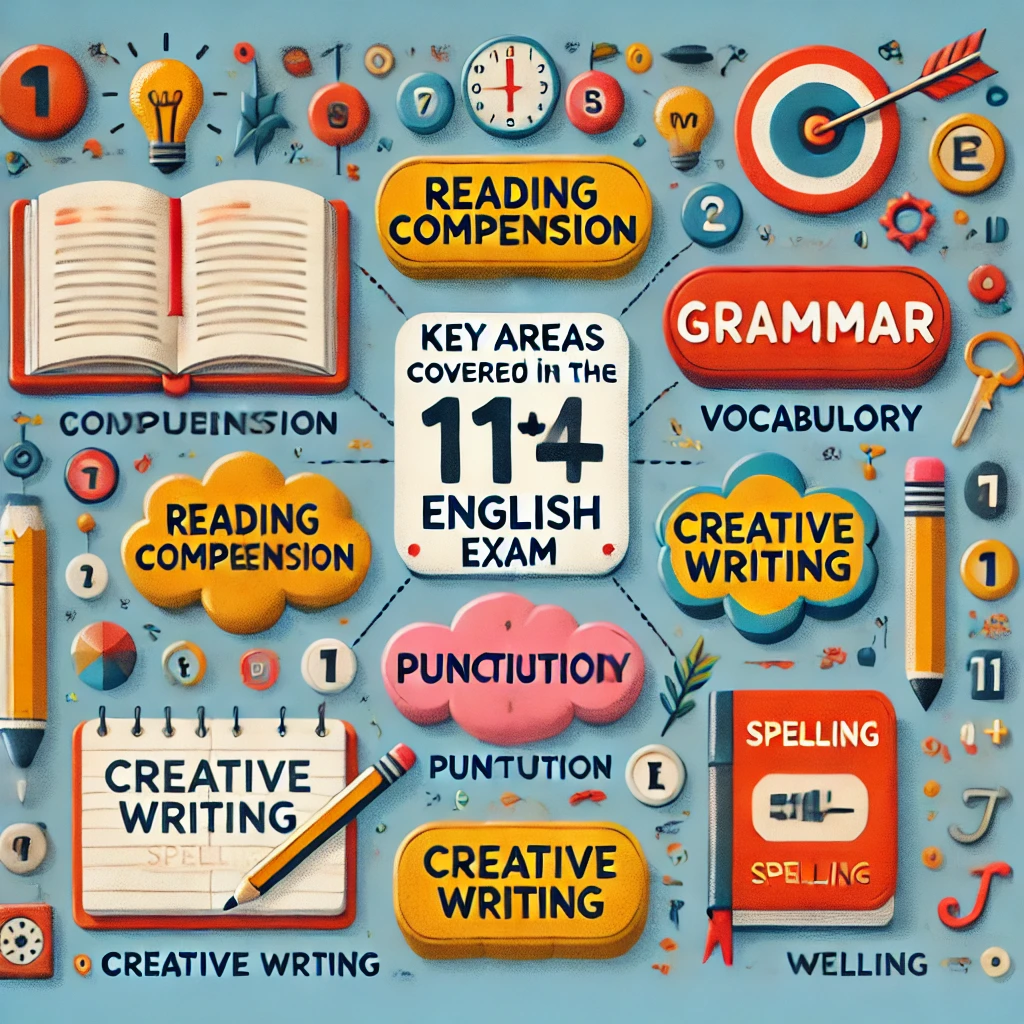
11+ English Language assesses several reading and writing skills that children may need for selective school entry. Although the exact content varies, the following areas commonly appear in English papers.
Comprehension
The 11+ English Language comprehension section tests how well pupils understand and analyse written passages. These may include fiction, non-fiction or poetry. Students are required to:
- Read and interpret the text: Understand the main themes, ideas, and nuances of the passage.
- Answer questions on the content: These may include direct questions (retrieving information) or more complex ones that test the student’s ability to infer meaning, interpret character motives, and analyse the author’s intent.
- Skills assessed: Inference, summarisation, deduction, and identifying literary devices such as metaphors and similes.
For example, pupils may infer a fictional character’s emotions from their actions or dialogue. This tests comprehension and analytical skills.
Grammar and Punctuation
This section focuses on the technical aspects of writing, testing students on:
- Grammar rules: Questions may include identifying parts of speech (nouns, verbs, adjectives), correcting verb tense errors, or recognising subject-verb agreement issues.
- Sentence structure: Students may need to restructure sentences for clarity or correctness, ensuring the correct use of conjunctions and modifiers.
- Common punctuation errors: Punctuation rules such as the correct use of commas, apostrophes, colons, semi-colons, and capitalisation are tested. Students must demonstrate their ability to punctuate sentences correctly, avoiding errors like misplaced apostrophes or run-on sentences.
Mastering grammar and punctuation is crucial not only for the exam but also for effective writing in secondary school and beyond.
Children who need broader support with sentence structure, accuracy and written expression can work with our English Language tutors to strengthen these skills over time.
Vocabulary and Spelling
Vocabulary and spelling form an important part of 11+ English Language, with questions commonly focusing on:
- Word meanings: Students are often asked to choose the correct synonym or antonym for a given word, or to identify the meaning of a word in context.
- Homonyms: Words that sound the same but have different meanings (e.g., “their” vs. “there”) are commonly tested, ensuring students can distinguish between them.
- Spelling accuracy: Spelling tests may involve selecting the correct spelling from a list of options or identifying misspelled words within sentences.
A strong vocabulary not only helps in understanding reading passages but also enhances creative writing by allowing students to express ideas more clearly and effectively.
Creative Writing
The creative writing section of the exam allows students to showcase their ability to:
- Develop a coherent narrative: They may be asked to write a story based on a prompt, such as describing an adventure or a favourite memory.
- Write persuasively: Some prompts might ask students to argue for or against a point of view, such as whether school uniforms should be mandatory.
- Use descriptive language: Examiners will look for the use of varied vocabulary, correct grammar, and well-structured sentences that convey clear and imaginative ideas.
Examiners assess creativity, planning (including the structure of the essay), and technical skills like grammar, punctuation, and use of literary devices. Practising different types of prompts helps students prepare for the variety of tasks they may face.
If writing forms part of the target school’s test, an 11+ Creative Writing tutor can help a child plan ideas, vary sentence structure and improve technical accuracy without relying on memorised stories.
Some children know the rules but find it difficult to apply them under timed conditions. Our 11+ English Language tutors can identify specific gaps, build a focused revision plan and help pupils practise each skill at a manageable pace.
11+ English Language Test Providers and Formats
11+ English Language does not follow one national format. Schools and local authorities choose the provider, subjects and question types used in their admissions tests. GL Assessment and Cambridge Insight, formerly associated with the CEM name, are well-known providers. Some schools also create their own papers or combine provider content with local questions. Always check the target school’s admissions guidance before choosing practice materials.
By passing the 11+ English exam, students demonstrate their academic potential and readiness for the more advanced secondary curriculum offered by grammar and independent schools.
GL Assessment
GL Assessment is a major 11 Plus test provider. It operates across Northern Ireland and parts of England. Its English tests often cover comprehension, grammar, punctuation and vocabulary. Some schools may also include writing tasks.
For a fuller breakdown of subjects, paper styles and preparation, read our GL Assessment 11 Plus papers guide.
Comprehension Tasks
- In the GL Assessment exam, comprehension questions are designed to test a student’s ability to understand and interpret written texts. These questions tend to focus on both fiction and non-fiction passages, requiring students to demonstrate skills such as inference, summarisation, and understanding of context.
- Typically, these tasks are structured, meaning students must answer specific questions rather than providing open-ended responses. This allows for a more uniform assessment of a student’s reading ability, which fits into the broader, formulaic style of the GL exam.
Writing Tasks
- The writing component in GL exams is more traditional and structured. It assesses how clearly pupils organise ideas, choose vocabulary and use grammar and punctuation. Tasks may involve a narrative, a descriptive paragraph or a response to a specific prompt.
- The formulaic nature of this approach ensures that students follow a particular format, which makes it easier to mark their responses objectively. Students are encouraged to use a wide range of vocabulary and varied sentence structures to demonstrate a higher level of writing proficiency.
Grammar, Punctuation, and Vocabulary
- GL Assessment places significant importance on evaluating grammar and punctuation. These questions are often multiple-choice or require students to identify mistakes in given sentences. The questions might ask students to identify errors in sentence structure, misplaced punctuation marks, or incorrect usage of tenses.
- The structured nature of the exam requires students to apply grammatical rules and conventions systematically. Vocabulary tests are designed to measure a student’s knowledge of word meanings, synonyms, antonyms, and contextual usage. These sections often have a more formulaic approach, with defined right or wrong answers, which ensures consistency in grading across a wide range of abilities.
Formulaic Approach
- GL Assessment’s reliance on structured questions reflects their formulaic approach to evaluating student performance. This method ensures objectivity and fairness, as there are clear guidelines for what constitutes a correct or incorrect answer.
- This approach is particularly evident in how grammar and punctuation are tested, where the focus is more on accuracy and rule-following rather than creative expression. This contrasts with other examination boards that might place more weight on creative thinking or open-ended responses.
In summary, GL Assessment focuses on core English skills. Its structured tasks test comprehension, writing, grammar, punctuation and vocabulary. This clear format helps keep the assessment consistent and easy to follow.
CEM
CEM (Centre for Evaluation and Monitoring) 11 Plus exams are designed to assess students across a broader range of skills, with a specific focus on verbal reasoning and English. This approach places greater emphasis on the ability to process and understand complex language structures. Here’s a detailed breakdown:
Verbal Reasoning Focus
- Verbal reasoning tests how well pupils work with words and solve language-based problems. CEM questions go beyond learning vocabulary by heart. Instead, pupils must understand and compare words in context. Tasks may include finding synonyms, choosing antonyms, completing sentences or spotting word patterns.
Emphasis on English
- English in the CEM exam goes beyond basic reading comprehension. In addition, it tests grammar, punctuation and spelling. Pupils must understand different texts, spot themes and make clear inferences. For example, passages may include fiction, non-fiction, poems or articles. As a result, pupils must adapt quickly to different writing styles and question types.
Unpredictable Question Types
- One key feature of CEM exams is the variety of question types. Unlike traditional tests, pupils may not know exactly what to expect. Therefore, they must think carefully and apply their knowledge in new ways. For example, tasks may include puzzles, inference questions or language-based logic problems. As a result, flexible thinking is just as important as subject knowledge.
Critical Thinking and Adaptability
- CEM tests aim to push students beyond rote learning by focusing on their ability to think critically. Students must be able to adapt to different question formats and reading materials with ease. This involves not just comprehension but also the ability to analyse information, infer meaning, and apply logical reasoning to language-based problems. For instance, a student might be asked to deduce the meaning of a word from its context or identify the main argument of a text while understanding subtle nuances.
Overall, CEM’s focus on verbal reasoning and unpredictable question types encourages students to develop critical thinking skills, linguistic dexterity, and adaptability. These skills are invaluable not only for passing the exam but also for their overall academic development.
Some schools may create their own exams or use a combination of GL and CEM formats, meaning the structure and difficulty of the exam may vary depending on the school. Understanding which board or format a specific school uses can help students tailor their preparation more effectively.
For a clearer explanation of the provider, question types and preparation, read our CEM assessment guide.
How to Prepare for 11+ English Language Exam

Effective 11+ English Language preparation should build accuracy before speed. Starting gradually gives children time to strengthen reading, vocabulary, grammar and writing before they begin full timed papers. Here are some effective strategies to help students maximise their preparation:
Start Early
- Building Core Skills: Early preparation allows students to develop a solid foundation in reading, writing, grammar, and vocabulary. Starting early helps them identify their strengths and weaknesses, ensuring ample time to focus on areas needing improvement.
- Routine Practice: Encourage a daily routine of reading and writing, even if it’s just for a short time. The more exposure they have to different texts and writing styles, the better prepared they will be for the exam.
Practice Papers
- Simulating the Exam: Practice papers help children apply their 11+ English Language skills and become familiar with the timing and question format used by their target school. These papers provide a clear idea of the exam format and question types, allowing students to become familiar with what they’ll face on exam day.
- Assessing Progress: Regular practice papers help track progress over time, revealing areas where the student may need extra help. Encourage students to complete papers under timed conditions to mimic the pressure of the real exam, which can also improve time management skills.
- Reviewing Mistakes: After completing practice papers, it’s crucial to review any mistakes made. Understanding why an answer was incorrect and how to avoid similar errors in the future is key to continuous improvement.
Reading for Success
- Importance of Reading: Reading widely and regularly is one of the best ways to improve comprehension, vocabulary, and critical thinking skills. Students should be encouraged to read a mix of genres, including classic literature, modern fiction, poetry, and non-fiction.
- Recommended Reading List: Some suggested books for building comprehension skills include:
- Charlotte’s Web by E.B. White – A classic children’s story that introduces rich vocabulary and themes.
- Carrie’s War by Nina Bawden – A historical novel that improves comprehension of narrative structure and character development.
- Goodnight Mister Tom by Michelle Magorian – A touching World War II story, ideal for understanding empathy and thematic depth.
- The Chronicles of Narnia by C.S. Lewis – For fantasy lovers, this series introduces imaginative language and descriptive writing.
Reading a variety of texts helps students understand different writing styles, sentence structures, and vocabulary, all of which are beneficial for both comprehension and creative writing sections.
Daily Writing Challenges
- Creative Writing Exercises: Writing regularly is essential for honing narrative skills. Set daily writing challenges that focus on different aspects of writing, such as:
- Personal stories: Encourage students to write about a personal experience or a memorable event. This helps develop narrative structure and descriptive writing.
- Persuasive essays: Ask students to write persuasive pieces on topics like “Should students wear uniforms?” This sharpens their ability to argue a point and use persuasive language.
- Descriptive paragraphs: Give prompts like “Describe your dream holiday” to improve their ability to use imagery and rich vocabulary.
- Character sketches: Have them create characters and develop stories around them, enhancing their creativity and ability to construct a coherent narrative.
- Stock Stories: Students can develop a few “stock stories” or templates for common creative writing prompts, such as adventure, family, or important memories. Practicing these will help them respond quickly and confidently on exam day.
By integrating these preparation strategies, students can build the skills and confidence needed to excel in the 11+ English exam. A mix of early preparation, targeted practice, and continuous learning through reading and writing will ensure a well-rounded approach.
4 Effective 11+ English Preparation Methods

Different preparation methods suit different learners. These four approaches can make 11+ English practice more focused, manageable and engaging.
1. Personalised Learning Plans
- Tailored Study Schedules: Every student has different strengths and weaknesses, so a “one-size-fits-all” approach may not be effective. Encourage parents and students to identify specific areas (comprehension, grammar, creative writing) where improvement is needed. Based on this, they can create a customised study plan that prioritises weaker areas while also revising strengths.
- How to Do This: Suggest starting with a mock test to identify gaps. For instance, if grammar is a weakness, the study plan might include daily grammar drills alongside weekly comprehension exercises.
- Daily or Weekly Goals: Break the plan into achievable goals, such as mastering 10 new vocabulary words per week or completing one comprehension test each weekend.
2. Interactive Learning
- Free Downloadable Study Planner: Provide your blog readers with a downloadable study planner. The planner could include sections for tracking progress, daily goals, and mock exam results. This gives students and parents a tangible tool to organise their learning.
- Interactive Quizzes: Incorporate interactive quizzes within your blog, such as vocabulary quizzes or comprehension tests. This not only makes the learning process engaging but also offers immediate feedback to the student, helping them identify areas that need more attention.
- Real-Time Assessment: Introduce tools where students can assess themselves in real-time. Quizzes that evaluate vocabulary, spelling, and reading comprehension can be included directly in the blog for users to practice on the spot.
3. Gamified Learning
- Learning Through Games: Learning apps can make the preparation process more enjoyable. Gamified learning involves incorporating game elements like points, levels, and rewards into educational activities, which is highly effective for younger learners.
- Apps for Spelling and Vocabulary: Recommend fun, educational apps that turn learning into a game. For example, apps like “Spelling Stage” or “Vocabulary.com” offer engaging ways to practise spelling and vocabulary through quizzes and interactive challenges.
- Grammar Games: Highlight apps that focus on grammar and sentence structure, such as “Grammaropolis” or “Sentence Ninja”. These apps are designed to make mastering grammar fun and interactive, turning it into a rewarding experience instead of a chore.
4. Mock Exam Strategy
- Simulating Exam Conditions: Preparing under real exam conditions helps reduce anxiety and improves performance. Recommend parents set up a mock exam environment at home to simulate the 11+ exam day.
- Time Management: Encourage students to practise answering papers within the given time limit, using a stopwatch or timer. This helps improve their time management skills and ensures they finish each section on time during the real exam.
- Review Mistakes Thoroughly: After each mock exam, students should not only check their answers but also review any mistakes carefully. Offer advice on how to identify patterns in mistakes (e.g., frequent punctuation errors or misinterpreted comprehension questions) and how to improve in those areas.
- Track Progress Over Time: Use mock exam results to adjust the personalised learning plan. If there is consistent improvement in one area, students can allocate more time to other weak spots.
Common 11+ English Language Mistakes
Common 11+ English Language mistakes include misreading comprehension questions, overlooking punctuation and starting writing tasks without a clear plan. Here’s how to recognise and avoid these pitfalls:
Comprehension Misinterpretations
One of the most frequent mistakes in comprehension is misinterpreting the question or failing to extract key information from the text. Students often jump to conclusions without fully understanding the context, leading to incorrect answers.
- Common Mistakes:
- Guessing the answer without referring back to the text, often resulting in vague or incorrect responses.
- Overlooking specific details like the tone, mood, or intent behind a character’s actions or an author’s message.
- How to Avoid:
- Methodical Approach: Teach students to read the passage thoroughly before attempting any questions. Encourage them to highlight or underline key details and look for clues within the text that can guide their answers.
- Re-read the Question: Before answering, they should re-read the question to ensure they understand exactly what is being asked and whether their answer directly addresses the question.
- Answer in Steps: For longer questions, it’s helpful to break down the answer into parts. If the question asks for multiple points (e.g., “What are two reasons…”), ensure students cover both and reference the text clearly.
Grammar and Punctuation Errors
Grammar and punctuation mistakes are common in students’ writing, especially when they’re under pressure. These errors can impact clarity and coherence, reducing marks in both comprehension and creative writing sections.
- Common Errors:
- Misuse of commas: Students often use commas incorrectly, either overusing them or neglecting to place them where necessary, leading to confusing sentences.
- Incorrect apostrophe usage: Misplacing apostrophes in contractions or possessive forms (e.g., “it’s” vs. “its”) is a frequent mistake.
- Run-on sentences: Students may write lengthy sentences without proper punctuation, making their ideas difficult to follow.
- How to Avoid:
- Punctuation Practice: Provide students with exercises specifically focused on commas, apostrophes, and sentence structure. Reviewing these rules regularly can help solidify their understanding.
- Short, Clear Sentences: Encourage students to write short, clear sentences first. As they gain confidence, they can combine ideas using conjunctions and clauses, but simplicity helps reduce errors.
- Proofreading: Remind students to leave time at the end of each writing task to proofread for basic grammar and punctuation errors.
Weak Creative Writing
Creative writing in the 11+ exam is an opportunity to showcase imagination, but many students overlook key elements like structure and vocabulary, leading to bland or disorganised responses.
- Common Issues:
- Weak Structure: Many students fail to plan their writing, resulting in stories that lack a clear beginning, middle, and end, or persuasive essays that don’t follow logical progression.
- Limited Vocabulary: Over-reliance on simple or repetitive words can make writing seem uninspired.
- Poor Use of Literary Devices: Students often forget to incorporate literary techniques like similes, metaphors, and imagery, which can elevate creative writing.
- How to Avoid:
- Planning and Outlining: Before writing, encourage students to spend a few minutes planning their story or essay. They should map out the structure (introduction, development, conclusion) and jot down key ideas and transitions.
- Vocabulary Enrichment: Introduce new vocabulary words regularly and encourage students to use varied language in their writing. They can keep a vocabulary journal to track new words and phrases they’ve learned.
- Practise with Prompts: Provide regular creative writing exercises based on typical 11+ exam prompts, such as “Write about an exciting adventure” or “Persuade your school to change a rule.” Review these together, pointing out where they can improve structure and creativity.
- Strong vs. Weak Examples: Show students examples of weak and strong creative writing. For instance, a weak response may simply state, “It was a nice day,” while a strong version might say, “The sun bathed the meadow in golden light, warming the breeze as it swept across the tall grass.” Highlight the difference in vocabulary, imagery, and sentence variation.
How Parents Can Support 11+ English Revision
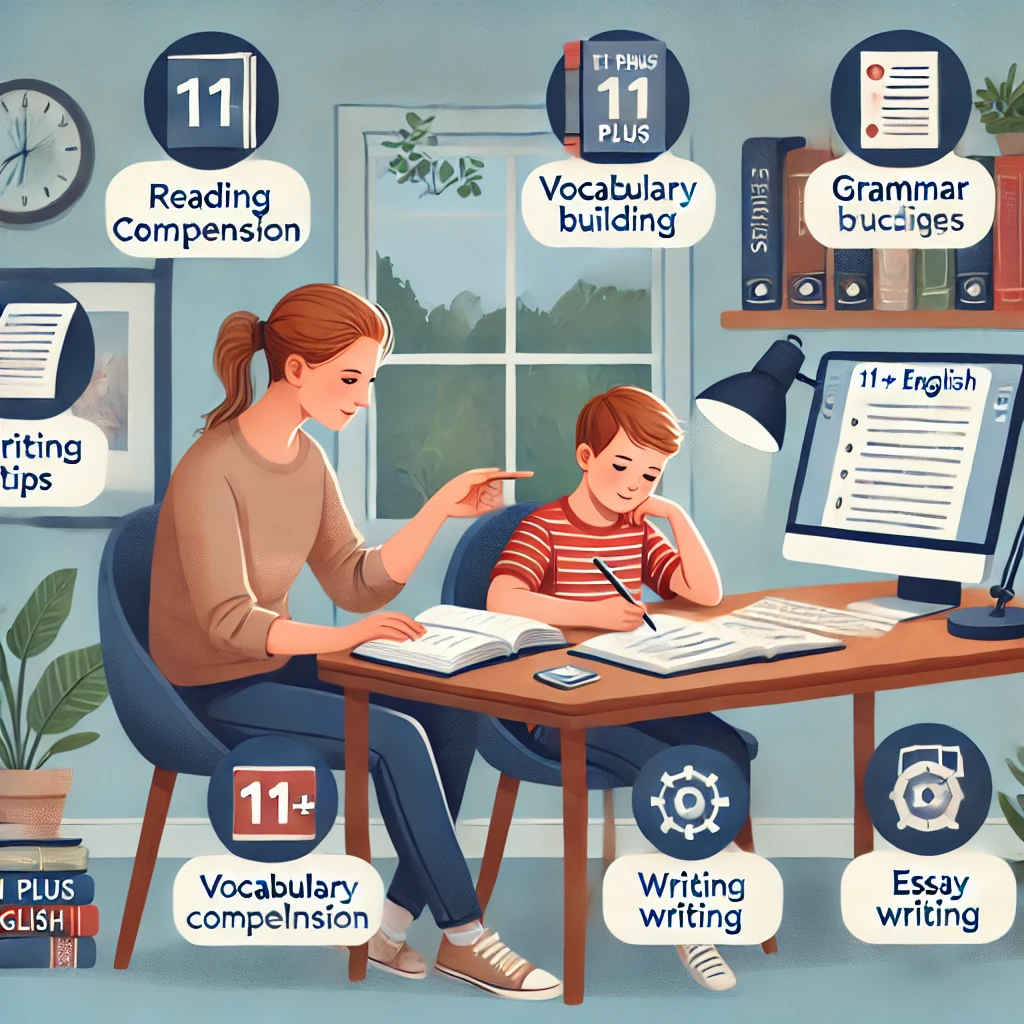
Parents can support 11+ English Language preparation through regular reading, short writing activities and calm review of practice-paper mistakes. The aim is to build a consistent routine without making revision feel overwhelming.
Parental Involvement in Exam Prep
- Constructive Feedback on Homework: Parents should review their child’s homework and practice papers regularly. Offering specific, constructive feedback can help children understand where they need to improve. Rather than pointing out everything that’s wrong, focus on 2-3 key areas for improvement, such as sentence structure or comprehension accuracy.
- Tip: Avoid overwhelming your child with too many corrections at once. Praise their strengths and address mistakes gradually to build their confidence.
- Reading Together: One of the most effective ways to boost a child’s reading comprehension and vocabulary is by reading together. Set aside time each day to read with your child. After reading, engage them in discussions about the plot, characters, and themes of the book.
- Tip: Ask open-ended questions like, “What do you think will happen next?” or “Why do you think the character made that choice?” This encourages deeper thinking and improves their ability to analyse texts.
- Setting Writing Challenges: Parents can set regular writing challenges to help improve their child’s creative writing and expression. Provide different types of writing tasks, such as persuasive essays or descriptive pieces, and encourage your child to practise different styles.
- Tip: Focus on one aspect of writing per challenge, such as vocabulary variety or sentence structure, to avoid overwhelming them with too many objectives.
Home-Based Creative Writing Prompts
To make creative writing more engaging, parents can set weekly writing challenges. These prompts help develop narrative skills and encourage imaginative thinking, while also reinforcing grammar and vocabulary.
Here are some example writing prompts that parents can use:
- Write about your dream adventure: Encourage your child to describe an exciting journey or expedition they would like to take. This can help develop descriptive writing and imagination.
- Describe a time you felt proud: This prompt allows children to practice expressing emotions through writing, developing both narrative skills and emotional intelligence.
- Persuade your school to change a rule: This teaches persuasive writing and logical argumentation, helping children structure their thoughts in a clear, convincing manner.
- Imagine you’re an animal for a day: This creative prompt helps students explore perspectives, building empathy and expanding vocabulary by imagining life through an animal’s eyes.
- Tip: Set a time limit for each writing prompt (e.g., 30 minutes) to simulate exam conditions and help your child develop the ability to write within a set timeframe.
By integrating these practical tips, parents can effectively support their child’s preparation for the 11+ English exam, ensuring they develop strong reading, writing, and critical thinking skills.
Why 11+ English Language Skills Matter Beyond the Exam
The skills developed through 11+ English Language preparation remain useful long after the entrance test. Reading critically, organising ideas and choosing words carefully can support learning throughout secondary school. These skills are not only foundational for success in secondary school but also provide lifelong advantages in both academic and real-world settings.
Lifelong Literacy Skills
- Critical Thinking: The comprehension and creative writing tasks in the 11+ English exam encourage students to think critically about what they read and write. This skill is vital in secondary education, where students are expected to analyse complex texts, formulate well-supported arguments, and engage in deeper academic discussions. Critical thinking is a skill that also translates into other subjects like history, science, and even mathematics.
- Example: In secondary school literature studies, students will need to dissect characters, themes, and literary devices in much more complex texts, using the analytical skills they developed during 11+ preparation.
- Structured Writing: The focus on planning and organising creative writing tasks for the 11+ exam helps students develop the ability to structure their thoughts clearly and coherently. This is crucial for success in essay-based subjects throughout secondary school, university, and even in professional careers. Whether they are writing a literature analysis or drafting a business report, structured writing skills help students communicate their ideas effectively.
- Example: In secondary school exams or coursework, students will need to plan essays that logically flow from introduction to conclusion, supported by well-organised evidence, a skill honed during 11+ preparation.
- Vocabulary Expansion: Vocabulary Expansion: Preparing for 11+ English Language exposes students to a wider range of words and helps them express ideas more precisely. These foundations also support later study, including GCSE English Language, where pupils need to analyse texts, compare viewpoints and communicate clearly.
Real-World Applications
- Effective Communication: The ability to analyse text, express thoughts clearly, and craft persuasive arguments in writing has real-world implications. From writing emails and reports to presenting ideas in meetings, these skills are essential for effective communication in both personal and professional life.
- Example: In a professional setting, clear and structured communication is crucial, whether it’s delivering a presentation, negotiating a deal, or writing a persuasive business proposal.
- Analysing Information: The reading comprehension and critical thinking skills honed during 11+ preparation also translate into the ability to sift through information and distinguish between relevant and irrelevant details. This is essential for making informed decisions in everyday life, such as understanding the terms and conditions of a contract, analysing news articles, or interpreting data.
- Example: In a world where we are constantly bombarded with information, critical reading skills help individuals assess the credibility of sources, making them more discerning consumers of information.
- Problem-Solving and Creativity: Creative writing tasks help students develop problem-solving and imaginative thinking. These skills are valuable in many professional fields, from marketing and advertising to research and development, where innovative solutions and creative approaches are highly sought after.
Conclusion
Success in 11+ English Language comes from steady, focused practice. Regular reading, vocabulary work, grammar exercises and reviewed practice papers can build both skill and confidence. Starting early also gives children time to improve weaker areas without feeling rushed.
Once the core skills are secure, introduce timed practice that matches the target school’s format. Short quizzes, reading tasks and writing activities can keep revision varied. Most importantly, review mistakes so your child understands how to improve.
Take the next step in your child’s journey by exploring Edumentors for personalised 11+ english tutors option and further resources. Let’s make sure your child is fully equipped to succeed in the 11+ English exam!
What Does 11+ English Language Cover?
11+ English Language commonly covers reading comprehension, vocabulary, spelling, grammar and punctuation. Some schools also include creative or persuasive writing. However, there is no single national paper, so the balance of topics, question style and timing can vary. Parents should check the target school or local admissions authority before choosing practice papers or planning revision.
Is 11+ English Language the Same in Every Area?
No. Schools and local authorities can choose different providers, subjects, timings and question formats. One area may use GL Assessment, while another may use a school-written paper or a different provider. Some tests use separate English sections and others combine English with verbal reasoning. Always prepare for the exact format used by the schools your child is applying to.
Does the 11+ English Exam Include Creative Writing?
Not always. Some grammar schools and independent schools include a separate creative writing task, while others assess English through comprehension, vocabulary, grammar and spelling questions. Where writing is included, pupils may need to produce a story, description, letter or persuasive response. Check the school’s admissions guidance before making creative writing a major part of the revision plan.
Is 11+ English Language Multiple Choice?
Many 11+ English papers use multiple-choice questions, especially for comprehension, vocabulary, grammar and spelling. However, some schools use standard written answers or add a separate writing task. The answer sheet and timing can also vary. Children should practise with materials that match the target school’s format rather than assuming every 11+ English paper works in the same way.
How Can My Child Improve Their 11+ English Comprehension?
Regular reading helps, but practice should be active. Ask your child to summarise a passage, explain unfamiliar words and support each answer with evidence from the text. They should practise retrieval, inference, vocabulary-in-context and author-intent questions separately before completing full timed papers. Reviewing why an answer was wrong is usually more valuable than rushing into another practice test.