

- How the EPQ Mark Scheme Works
- AQA EPQ Mark Scheme: The Four Assessment Objectives
- Key Features of a High-Mark EPQ
- EPQ Grade Boundaries Explained
- AQA EPQ Grade Boundaries: Latest Published Results
- Edexcel EPQ Grade Boundaries: Why the Numbers Differ
- How to Use the EPQ Mark Scheme While You Work
- Does an EPQ Grade Matter for University Applications?
- Common Mistakes That Can Lower EPQ Marks
- Conclusion
An EPQ mark scheme explains how assessors award marks for the Extended Project Qualification. It covers more than the final report, artefact or presentation. Instead, it looks at planning, research, decisions, the final outcome and reflection. Grade boundaries then show the minimum overall mark for an A*, A, B, C, D or E.
The EPQ mark scheme and grade boundaries answer different questions. The criteria show what strong work looks like. By contrast, grade boundaries turn a total mark into a final grade. This guide explains the AQA EPQ mark scheme, the latest published AQA boundaries, Pearson Edexcel scoring and how to use the criteria as you work.

How the EPQ Mark Scheme Works
The EPQ mark scheme rewards work from the first idea to the final presentation. Therefore, a polished report alone will not secure the highest marks. Assessors also look for clear planning, suitable research, sound decisions and an honest review.
Before comparing marks, it helps to understand what an EPQ involves. For AQA, students submit a production log, project product and evidence from their presentation. The product may be a research report. Alternatively, it can be an artefact, performance or another practical outcome with a written report.
AQA uses one EPQ mark scheme for different project types. So, a dissertation and artefact do not need to look the same. However, both must show the same key skills. Read the AQA EPQ specification for the official criteria.
Teachers mark the work first. The school or college then standardises the marks. Finally, AQA moderates a sample. As a result, students should make their evidence easy to follow.
AQA EPQ Mark Scheme: The Four Assessment Objectives
The AQA EPQ mark scheme has four assessment objectives. Together, they make up 50 raw marks. AO3 has the greatest weighting. Still, planning, research and reflection account for 60% of the total.
| Assessment objective | Weighting | What it means |
| AO1: Manage | 20% | Set a clear title and aims. Plan the work, track progress and stay organised. |
| AO2: Use Resources | 20% | Select useful sources, judge their value and use them to support your ideas. |
| AO3: Develop and Realise | 40% | Make informed choices, solve problems and complete an outcome that meets the agreed aims. |
| AO4: Review | 20% | Evaluate the process, explain what you learned and present clear conclusions. |
AO1: Manage
AO1 checks how well you plan and manage the project. High-mark work has a focused title, clear objectives and a detailed plan. It also shows how you monitored progress.
A plan can change. In fact, a sensible change may strengthen an EPQ. However, explain what changed, why it changed and how the decision helped.
AO2: Use Resources
AO2 looks at research. Strong projects use suitable sources and evaluate them. For example, you may compare a journal article with a news report, then explain which gives stronger evidence.
You also need to use research to build an argument. A long reference list without analysis will not reach the higher mark bands.
AO3: Develop and Realise
AO3 carries the most marks in the AQA EPQ mark scheme. It assesses how well you turn planning and research into a finished outcome. A dissertation needs a logical answer to the title. An artefact needs to meet its project aims and have clear supporting evidence.
It also rewards sound decisions. Explain how you solved a problem, changed a method or narrowed the scope. Then show how this improved the outcome.
AO4: Review
AO4 covers evaluation and presentation. A high-mark review explains real strengths and limits. It also shows what you learned.
The presentation matters too. Make your findings clear for a non-specialist audience. Then answer questions using your research, decisions and conclusions.
Key Features of a High-Mark EPQ
A high-mark EPQ does not need a perfect first plan. However, it should show clear evidence of independent work, careful thinking and informed decisions from the first idea to the final presentation.
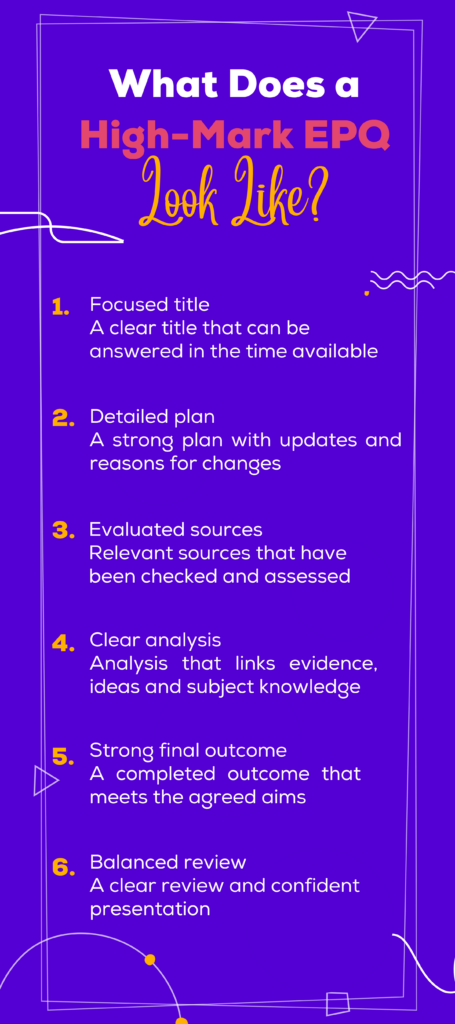
In contrast, weaker projects often have titles that are too broad, source lists with little evaluation or reflections that only describe what happened. Therefore, students should keep asking: “What evidence shows that I have met this objective?”
An EPQ runs alongside other Level 3 study. Because of that, students need a routine that protects time for A Levels as well as the project. A-Level tutors can help students organise their wider workload and avoid last-minute pressure.
EPQ Grade Boundaries Explained
The EPQ mark scheme gives you a raw mark. Grade boundaries show which final grade that mark receives. A boundary is the lowest mark needed for a grade in a particular assessment series.
For example, when the A boundary is 40, a mark of 40 earns an A. A mark of 39 falls into the next grade down. However, boundaries can change between years and boards. So, never use an old table as a guaranteed target.
AQA uses raw marks out of 50. Pearson Edexcel uses raw marks for project units, then converts them into an overall points score. As a result, AQA and Edexcel numbers cannot be compared directly.
AQA EPQ Grade Boundaries: Latest Published Results
When this guide was updated, the latest published AQA grade-boundary tables were for 2025. The June and November boundaries were the same. They are useful as a reference. However, students taking a later series must check the new official table.
| Grade | AQA EPQ raw mark needed in 2025 |
| A* | 45 / 50 |
| A | 40 / 50 |
| B | 35 / 50 |
| C | 30 / 50 |
| D | 25 / 50 |
| E | 21 / 50 |
Check AQA’s June 2025 EPQ grade-boundary table and ask your school or college to confirm the correct results series.
These figures do not predict later boundaries. They also do not apply to Pearson Edexcel EPQs. Therefore, use them to understand the scale, not to estimate a future grade.
Edexcel EPQ Grade Boundaries: Why the Numbers Differ
Pearson Edexcel has separate project units for a dissertation, investigation or field study, performance and artefact. In June 2025, each unit had a maximum raw mark of 54, while the A* boundary was 50. The overall qualification used a points score out of 28, where 24 points earned an A*.
This differs from AQA’s 50-mark scale. However, it does not mean one board is easier. Each board uses its own assessment and awarding process. Always check the board named by your school or college.
How to Use the EPQ Mark Scheme While You Work
The EPQ mark scheme should guide your work from the start. Do not wait until the last week to compare your project with the criteria. Instead, use it as a short checklist at each stage.
At the start, check that your title is focused and your aims are realistic. Next, record why you chose your sources. During the project, note key decisions, setbacks and changes. Finally, compare the outcome with your original aims before the presentation.
Collect evidence for each objective:
- AO1: title, aims, plan and progress reviews
- AO2: source notes, evaluation and analysis
- AO3: drafts, decisions and final outcome
- AO4: evaluation, presentation slides and question responses
Students should complete their own EPQ. Yet they do not need to manage the wider pressure alone. When deadlines clash, families can find a tutor to support study routines and confidence alongside the student’s independent work.

Does an EPQ Grade Matter for University Applications?
An EPQ grade can give students an example of research, independence and commitment. However, entry requirements still come first. A strong project does not replace the grades or subjects a course requires.
A University Application Guidance tutor can help students judge whether the project supports their degree plans. Later, a Personal Statement tutor can help them select relevant learning from the project.

Common Mistakes That Can Lower EPQ Marks
The EPQ mark scheme rewards the whole process. Therefore, a good final report cannot fully make up for a weak production log or rushed review.
Avoid these mistakes:
- choosing a title that is too broad
- collecting sources without checking their value
- making changes without recording the reasons
- describing research instead of analysing it
- treating the production log like a short diary
- writing a vague final review
- preparing the presentation at the last minute
Keep evidence organised from the beginning. Then revisit the objectives every few weeks. Small checks will save a grim end-of-project scramble.
Conclusion
The EPQ mark scheme is a practical guide for planning, researching, developing and reviewing your work. Focus on all four objectives from the beginning. Then use the latest official grade boundaries for your own board and results series.
You Might Be Interested In
UCAS Personal Statement – A Secret to UK University Admissions
FAQs
What is an EPQ mark scheme?
An EPQ mark scheme sets out how assessors award marks. For AQA, it covers managing the project, using resources, developing the outcome and reviewing the work.
How many marks is an AQA EPQ worth?
The AQA EPQ mark scheme is worth 50 raw marks. AO1, AO2 and AO4 each account for 20%. AO3, Develop and Realise, accounts for 40%.
What are the AQA EPQ grade boundaries?
In 2025, AQA’s boundaries were 45 for A*, 40 for A, 35 for B, 30 for C, 25 for D and 21 for E. However, boundaries can change, so check the official table for your series.
Does the production log affect EPQ marks?
Yes. The production log provides evidence for planning, research, decision-making and review. Without clear records, it is harder to show that you have met the EPQ marking criteria.
Can EPQ grade boundaries change each year?
Yes. Grade boundaries can change by assessment series. They may also differ between AQA and Pearson Edexcel. Therefore, do not rely on a past table for a final target.

EPQ: What Is the Extended Project Qualification?