
Art and Design are more than a final image. At GCSE, it is a practical subject. Students build ideas. They try materials. They also record what they see. Then they create a final piece that shows their intention. The course is called GCSE Art and Design. It includes fine art photography, graphic communication, textile design and three-dimensional design. Because of this, examiners judge the process as well as the final work and not the skill alone.
AQA GCSE Art and Design has two parts. First, students complete coursework. Next, they complete an externally set assignment. Importantly, the same assessment objectives apply to both. These objectives reward artist research and experiments. They also reward observation and clear decisions. As a result, it helps to understand the course before you look at the AQA GCSE Art themes for 2026.
What Are AQA GCSE Art Themes?
AQA sets the themes for GCSE Art and Design through the externally set assignment. Because of this, the school does not choose them and the student does not choose them, either. Instead, each paper gives a set of starting points, which people often call themes or questions. From there, students pick one starting point and build a personal response.
However, the theme only starts the project. Examiners award marks for how students explore, test and refine ideas over time. As a result, two students can choose the same theme and still produce very different work. This variety is normal and GCSE Art expects it.
How the AQA Art GCSE Externally Set Assignment Works
For AQA, the externally set assignment is called Component 2. It contributes 40 percent of the final GCSE Art grade. The remaining 60 percent comes from coursework completed earlier in the course.
Once AQA releases the paper, students begin preparatory work in their GCSE Art sketchbook. This work includes research, experiments, observation and planning. After the preparation period, students complete a 10-hour supervised final outcome. Once this supervised time begins, students cannot add new preparation work.
This structure allows students to explore ideas in depth before producing a final piece under controlled conditions.
When Are the AQA GCSE Art Themes for 2026 Released?
AQA releases the externally set assignment on 2 January in the exam year. This release date applies every year, including the 2026 exam series. After this date, schools decide when students begin working on the assignment.
Teachers must give students the paper in full. They cannot change, shorten or adapt it in any way. This ensures that all students complete the assessment under the same conditions.
Where Students Get the Official AQA Art GCSE Themes
AQA sends the official themes to schools as part of the externally set assignment, so students get them through their art teacher or exams office rather than from public websites. For that reason, you should treat any full theme lists posted online before the release date with caution and focus instead on understanding the official AQA GCSE Art and Design assessment structure.
If you see full theme lists online, before January, treat them with caution. Reliable preparation focuses on understanding how the exam works, rather than trying to predict the questions.
What Examiners Look for in GCSE Art (AO1–AO4)
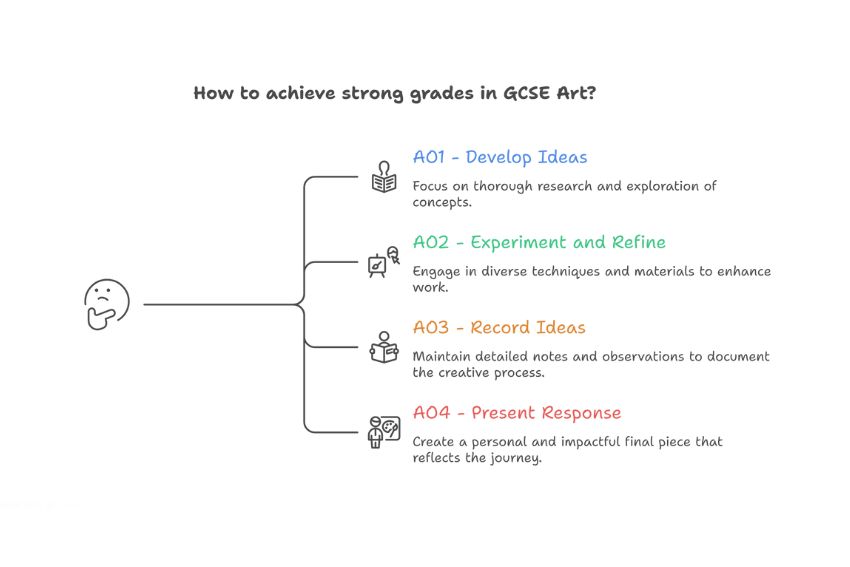
Examiners use four assessment objectives to mark GCSE Art and Design and they use the same objectives for coursework and the externally set assignment. First, students show how they research and develop ideas. Next, they test materials and improve what works. They also record what they see through drawing photos and studies from real sources. Finally, they create a personal outcome that links back to earlier pages. Because of this, students need balance across all four areas. A strong final piece cannot fix weak development and lots of research without direction will still limit marks.
How to Choose the Right AQA GCSE Art Theme
There is no single best theme. The strongest choice is the one you can explore properly. Choose a starting point that allows you to collect your own photos, drawings or observations. This gives you control and flexibility.
Avoid themes that rely only on imagination. GCSE Art rewards evidence development and clear decision-making. At this level, practical access matters more than originality.
Turning an AQA GCSE Art Theme Into a Strong Project
A strong project shows a clear journey. It begins with broad ideas and gradually becomes more focused. Each page should show what you tried, what you learned and what you changed.
Examiners look for purposeful progress. Experiments should not feel random. Instead, each test should lead to the next decision.
Developing Ideas From Your GCSE Art Theme
Start by breaking the theme down into smaller parts you can explore. Think about contrasts as well as materials, emotions and settings linked to it. Then sketch a range of quick ideas without judging them too early. Add short notes as you go so you can explain why an image stands out or what you want to test next. You can also list keywords, collect a few initial photos, or make a simple mind map to widen your options.
This early stage matters because it shows real development. It helps examiners see that you shape ideas step by step over time and not by guessing at the last minute.
Artist Research for AQA Art GCSE Themes
Artist research should support your ideas and not replace them. Choose artists whose techniques, materials or concepts link clearly to your theme. Analyse how they work and then explain how this influences your own decisions.
Avoid copying an artist’s style directly. Instead, use research to inform choices and guide experiments.
Experimenting and Refining Work in GCSE Art
Experiments should test specific ideas. You might change materials, scale, composition or colour. Keep outcomes small and focused and then reflect briefly on what worked and what did not.
Refinement involves selecting the strongest results and improving them further. More experiments are not always better if they repeat the same idea.
Planning the Final Outcome for Art GCSE
Plan your final outcome well before the 10-hour supervised session begins. Choose your materials, decide on composition and settle on an approach. Create a clear sketch of your final idea and write a short step-by-step plan.
Include what you will do first, what you will add later and how you will refine details near the end. A strong plan keeps you focused, reduces stress and helps you work with confidence. It also shows clear intent and links your preparation to your final outcome.
What Your GCSE Art Sketchbook Should Include
A strong sketchbook shows the full process. This includes idea, development, primary sources, artist research, experiments and planning. Pages should feel connected, rather than separate.
Written annotation can stay brief. It only needs to explain intentions and decisions clearly.
Common Mistakes With AQA GCSE Art Themes
Students often lose marks for reasons that are not immediately obvious. Work may look neat and finished, yet the sketchbook does not clearly show how ideas developed.
Common mistakes include focusing too much on presentation and not enough on idea development, including too many artists without showing influence, leaving annotation until the end and forgetting that GCSE Art assesses thinking as much as making.
Avoiding these issues protects marks and makes the project easier to manage.
Conclusion
GCSE Art and Design rewards steady work and clear decision-making. Your theme does not decide your grade. Your process does. If you want more support as you work through the AQA 2026 starting points, you can read our blog for practical tips you can use straight away.
Focus on all four assessment objectives by developing ideas, testing materials, recording observations and presenting a personal final response. Start early, work step by step and keep annotations brief, but specific. If your child needs extra support from an excellent GCSE Art online tutor during their GCSE journey, you can also explore our tutoring platform and find the right match. When each page leads clearly to the next, the 2026 themes feel like a useful starting point rather than a source of pressure.
FAQs
When are the AQA GCSE Art themes for 2026 released?
AQA releases the externally set assignment for GCSE Art and Design on 2 January in the exam year. This includes the 2026 exam series. Schools then decide when students begin working on it after that date.
Do all students get the same AQA GCSE Art themes paper?
Yes. All students taking AQA GCSE Art and Design receive the same externally set assignment paper. Each student chooses one starting point and develops their own personal response.
How many themes are included in the AQA GCSE Art externally set assignment?
The AQA Component 2 paper includes seven different starting points for each endorsement, such as Fine Art, Photography or Graphic Communication. Students must choose one theme only.
How much does the AQA GCSE Art exam count towards the final grade?
The externally set assignment known as Component 2 contributes 40 percent of the final GCSE Art and Design grade. The remaining 60 percent comes from the moderated coursework portfolio.