
Memory helps you take in information, store it, and use it later. In GCSE Psychology, exam questions often focus on memory types. So you need to understand each one clearly. This helps you explain behaviour, give strong examples, and avoid common mistakes. In this guide, you will learn what memory is and the main memory types in psychology. You will also see how GCSE exams test them. As a result, your revision will feel clearer and more manageable.
GCSE Psychology Memory – What Is Memory?
In GCSE Psychology, memory means taking in information, storing it, and using it later. First, you encode information so your brain can process it. Next, you store it so you can keep it over time. Finally, you retrieve it when you need it. Because each step works in a different way, psychologists study the types of memory in psychology. This helps explain why some information lasts seconds, while other memories last for years.
Types of Memory in Psychology
In psychology memory has three main stores. These are sensory memory short term memory and long term memory. Each store has a simple job. Together they show how information enters memory and how it stays there. Because of this GCSE exams often include questions on types of memory in psychology.

The 3 Types of Memory in Psychology
Psychologists describe three main memory stores. Each store has its own purpose. When you learn them one by one the topic feels much clearer. You can see how information starts in memory and where it goes next. This also makes revision easier. You can compare each store using coding capacity and duration and you can answer exam questions with more confidence.
Sensory Memory
Sensory memory is the first stage of memory. It holds information from the senses for a very short time. This includes sights and sounds. For example you may still see an image for a moment after it disappears. This shows sensory memory. It matters because it helps you notice what is happening around you.
Short Term Memory (STM)
Short term memory holds information for a short time. You use it when you actively think about something. For example remembering a phone number before you dial it uses short term memory. This store has a small capacity and short duration. These limits often appear in GCSE Psychology memory questions.
Long Term Memory (LTM)
Long term memory stores information for a long time. Some memories can last for life. Long term memory can hold a lot of information. It also lasts much longer than short term memory. This store includes different systems. This is why psychologists describe different types of memory in psychology.
Key Features of Memory in GCSE Psychology
In GCSE Psychology exams you often compare the memory stores. This is a common question style. Psychologists use three simple features to do this. These features are coding capacity and duration. Coding tells you how the store keeps information. Capacity tells you how much it can hold. Duration tells you how long it lasts. If you learn these three features you can explain memory stores clearly and you can pick up marks fast.
Coding
Coding shows how information is stored. Sensory memory stores information as images and sounds. Short term memory often uses sound. Long term memory mainly stores meaning.
Capacity
Capacity shows how much information a memory store can hold. Sensory memory takes in a lot of information but only for a moment. Short term memory holds a small number of items. Long term memory can store a very large amount of information.
Duration
Duration shows how long information stays in a memory store. Sensory memory lasts for a split second. Short term memory lasts a few seconds unless you repeat the information. Long term memory can last from minutes to a lifetime.
Different Types of Long Term Memory
Long term memory does not work as one single store. Instead psychologists divide it into types. This makes explanations clearer in exams.
Episodic Memory
Episodic memory stores personal events. These memories link to a time and a place. For example you may remember your first day at secondary school.
Semantic Memory
Semantic memory stores facts and general knowledge. These memories do not link to one specific event. For example you know that Paris is the capital of France.
Procedural Memory
Procedural memory stores skills and actions. You use it when you do something without thinking about each step. These skills feel automatic because you practise them many times. For example you use procedural memory when you ride a bike. You also use it when you tie your shoelaces. You use it again when you type without stopping to think.
Common Mistakes
Students often learn the definitions. Even so they still lose marks in exams. This happens because some memory types sound alike. For example students may mix up episodic memory and semantic memory. Also they may give an example but not explain why it fits. As a result the examiner cannot award full marks. In addition some students describe procedural memory in a vague way. This makes the answer hard to credit. Next some students mix up procedural memory and declarative memory. This can change the meaning of the whole point. Finally students sometimes use general words instead of the correct key terms. Because of this the answer sounds less accurate and less exam focused.
Murdock Serial Position Curve Study
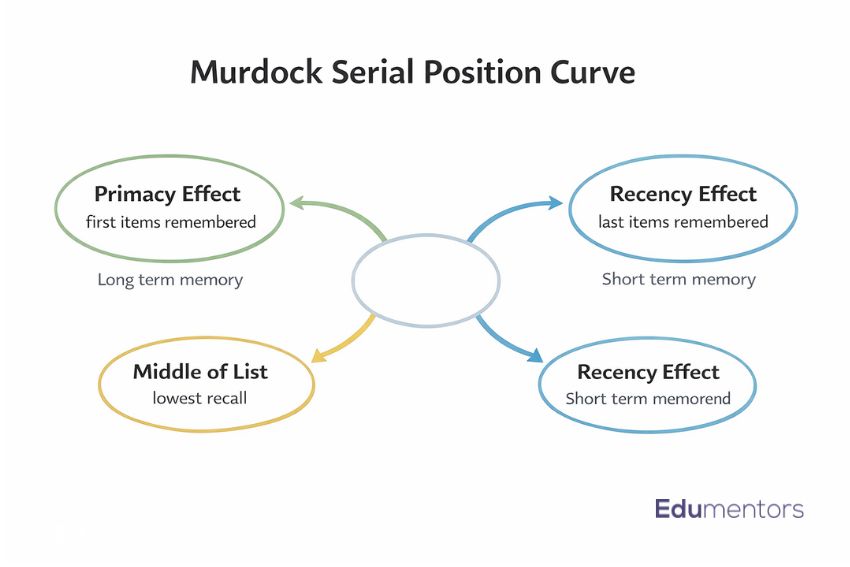
Murdock’s serial position curve study helps you apply what you have learned about memory stores. So far you have seen that memory includes sensory memory short term memory and long term memory. You have also learned that each store has different coding capacity and duration. The serial position curve shows this in action. People often remember the first and last items in a list best and they recall fewer items from the middle. This pattern links the first items to long term memory and it links the last items to short term memory. Because of this the study often appears in GCSE Psychology memory exams.
Aim of the Study
Murdock wanted to see how the position of an item in a list affects recall. In particular he looked at whether people remember words at the start middle or end of a list best. To do this he compared how well participants recalled words from each position. This helped him see if item order made a clear difference to memory performance.
Procedure and Findings
Participants heard lists of words. They then recalled the words in any order. Recall was high at the start and end of the list. Recall was lower in the middle.
What the Serial Position Curve Shows About Memory
The pattern shows two effects. The primacy effect happens because early words enter long term memory through rehearsal. The recency effect happens because later words stay in short term memory.
Strengths and Limitations
The study used controlled conditions. This means Murdock could keep the task the same for each participant. Because of this the results are more reliable and easier to repeat. Also it is easier to compare recall across different list positions. However the task lacks realism. People do not usually memorise random word lists in daily life. In real life memory often involves meaning context and emotion. As a result the findings may not fully reflect how memory works outside the lab.
Psychology Memory Revision How Exams Test Memory
In GCSE Psychology memory questions test three skills. These are define describe and apply. First write a clear definition. Next add one key detail such as capacity or duration. Then give one example and explain why it fits. Keep answers short. Clear answers score more marks than long ones.
Types of Memory in Psychology Key Takeaways
Here’s a clearer and more readable version that fits the tone of the rest of the text:
Psychologists divide memory into clear systems. For GCSE Psychology you only need to remember a few key ideas. There are three memory stores. These are sensory memory short term memory and long term memory. There are also three types of long term memory. These are episodic memory semantic memory and procedural memory. Finally, Murdock showed that people recall items best at the start and at the end of a list.
Final Thoughts
Memory is a key GCSE Psychology topic. Once you understand the memory types the topic feels simpler. Start by learning the three memory stores. Then learn the three types of long term memory. After that link the topic to evidence using the serial position curve.
When answering questions write clearly. Start with a definition. Add one key detail. Finish with an explained example. This structure keeps answers focused and easy to mark. Regular practice will improve speed and accuracy.
FAQs:
What are the three types of memory in psychology?
The memory system has three main stores. These are sensory memory short term memory and long term memory. Long term memory includes episodic semantic and procedural memory.
What is the difference between STM and LTM?
Short term memory stores a small amount of information for a short time. Long term memory stores much more information and lasts much longer.
How do episodic semantic and procedural memories differ?
How do episodic semantic and procedural memories differ?
What does the serial position effect show?
The serial position effect shows better recall for the first and last items in a list. Items in the middle are remembered less well.