
What Makes a Good Tutor? 5 Qualities to Look For

What makes a good tutor? A good tutor combines strong subject knowledge, clear explanations, patience and lessons tailored to your child’s needs. They identify gaps in understanding, give useful feedback and help students tackle tasks with greater confidence and independence.
However, choosing the right person means looking beyond qualifications. The benefits of hiring a private tutor depend partly on how well their teaching matches your child’s level, goals and support needs.
This guide explores five qualities of a good tutor, explains what effective online teaching looks like and shares practical questions to ask before booking. Whether you need GCSE, A-Level or 11+ support, these checks will help you choose a tutor who suits your child.
Qualities of a Good Tutor at a Glance
The qualities of a good tutor should be easy to spot in their teaching. Use the table below to see what each quality looks like in practice and which questions to ask when comparing tutors for your child.
| Quality | What it looks like in a lesson | What parents can ask |
| Subject and curriculum knowledge | Accurate explanations and tasks suited to the student’s level | Have you taught this subject, qualification and exam board? |
| Clear communication | Ideas explained in small steps, followed by checks for understanding | How would you explain a topic my child finds difficult? |
| Patience and encouragement | Students can ask questions and make mistakes without embarrassment | How do you support a student who has lost confidence? |
| Personalised teaching | Lessons respond to gaps, goals and the student’s answers | How will you decide what my child needs to work on? |
| Structure and feedback | Clear lesson goals, useful feedback and regular progress reviews | How will you show us whether the lessons are helping? |
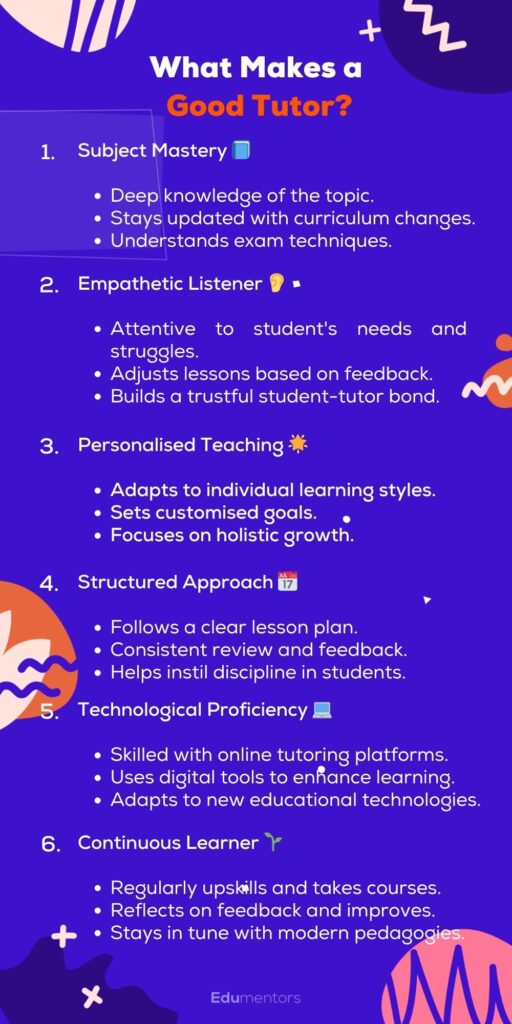
What Makes a Good Tutor? Five Essential Qualities
1. Strong Subject and Curriculum Knowledge
A good tutor understands the subject well enough to explain why an answer works. They should also recognise common mistakes and help students connect new ideas with what they already know.
For exam preparation, check their knowledge of the qualification, specification and assessment format. A tutor who supports GCSE students should be able to explain how they use relevant questions and mark schemes.
For example, when comparing GCSE Maths tutors, ask about your child’s exam board and Foundation or Higher tier. For A-Level tutors, check their experience with the topics your child finds hardest.
Strong grades and university credentials provide useful background. However, ask how the tutor turns that knowledge into teaching your child can follow.

2. Clear Explanations and Active Listening
Clear communication is one of the most useful tutor skills. A tutor should break a difficult idea into manageable steps, choose a relevant example and give the student time to respond.
Listening matters too. Rather than asking only “Do you understand?”, good tutors ask students to explain their thinking or attempt a similar question. Their answers reveal whether the explanation has worked.
For instance, an English tutor might model one analytical paragraph before asking the student to write their own. A Maths tutor might demonstrate a method, then gradually reduce the support.
During an introductory meeting, notice whether the tutor speaks directly to your child and gives them space to ask questions.
3. Patience, Empathy and Encouragement
Students may need several attempts before a topic becomes clear. A patient tutor responds calmly, tries another explanation and treats mistakes as useful clues.
Empathy also helps a tutor understand what sits behind a difficulty. A student who avoids questions may feel anxious about getting them wrong. Another may understand the topic but struggle to organise an answer under time pressure.
Encouragement should be specific. “You explained that step clearly” gives a student more useful feedback than general praise alone.
These characteristics of a good tutor are especially worth checking if your child has lost confidence. Ask how the tutor would respond when a student gets stuck or becomes frustrated.
4. Teaching That Responds to the Student
Personalised teaching starts with finding out what the student can already do. A tutor might review schoolwork, discuss recent feedback or use a few short questions to identify gaps.
They should then adjust the pace, explanations and practice tasks in response. For example, a student struggling with algebra may first need help with fractions or negative numbers.
Using diagrams, spoken explanations and worked examples can be helpful. However, students should not be placed into fixed “visual”, “auditory” or “kinaesthetic” learning categories. The Education Endowment Foundation’s guidance on learning styles explains the limited evidence behind this approach.
When comparing GCSE tutors, ask how they would adapt their plan after reviewing your child’s work.
5. Clear Structure, Reliability and Useful Feedback
A productive lesson should have a clear purpose. Students should know what they are working on, have time to practise and finish with a useful next step.
Reliability matters alongside teaching ability. Tutors should arrive prepared, communicate clearly about arrangements and explain what practice would help between sessions.
Feedback should show the student what to change and how to do it. “Add evidence” is less useful than identifying where an example is missing and showing how it would strengthen the answer.
The Education Endowment Foundation’s review of one-to-one tuition highlights the value of identifying learning gaps, linking tuition to classroom content and monitoring progress. Parents can use those principles when discussing a tutoring plan.
Meet Our Tutors

Kufreabasi E.
Computer Science | Physics | Biology Tutor
Student at King's College London
£100 / session
Book a free trialKufreabasi E.
Computer Science | Physics | Biology Tutor
Student at King's College London
£100 / session
Book a free trialGood Tutors Can Personalise Their Lessons
In the realm of education, a one-size-fits-all approach often falls short in meeting the diverse learning needs of students. This is where personalised teaching comes into play, particularly in a tutoring setting.
Understanding Personalised Teaching 🎯
Personalised teaching refers to tailoring the teaching process to accommodate the individual learning needs, preferences, and goals of each student. It involves understanding the student’s strengths, areas of improvement, and learning style to create a bespoke teaching strategy.
The Impact of Personalised Teaching on Student Performance 📈
When teaching is tailored to a student’s individual learning style, it leads to improved understanding and retention of information. It can help students engage more deeply with the subject matter, enhance their critical thinking skills, and foster a love for learning. By focusing on their strengths and working on their weaknesses, personalised teaching can also significantly boost a student’s self-confidence.
How to Choose the Best Tutors for Your Child
The best tutors for your child will match their subject needs, explain ideas clearly and offer a realistic plan. Before comparing profiles, note the subject, qualification, exam board and main reason you are seeking support.
Then use an introductory meeting to ask:
- Have you supported students at this level and with this exam board?
- How would you identify my child’s gaps in understanding?
- What would the first few lessons focus on?
- What practice would you suggest between sessions?
- How will you review progress and share feedback?
- What are the session length, price and cancellation terms?
For younger pupils, ask how the tutor keeps tasks clear and manageable. When choosing 11+ tutors, check their experience with the relevant entrance test and question types.
Finally, involve your child in the decision. Ask whether the tutor’s explanations made sense and whether they felt comfortable asking for help. A short meeting cannot prove long-term effectiveness, but it can help you assess the initial fit.
What Makes an Effective Online Tutor?
An effective online tutor combines clear teaching with tools that let the student take an active part. A shared whiteboard, screen sharing and digital resources are useful when they make explanations or practice easier.
However, the student should do more than watch. Ask how the tutor encourages them to solve questions, explain an answer or annotate a text during the session.
Look for these practical signs:
- Clear sound and readable teaching materials.
- Resources prepared for the subject and lesson goal.
- Regular questions that check understanding.
- Opportunities for the student to show their working.
- A clear plan if a connection or technical problem interrupts the lesson.
Online teaching should also have clear communication boundaries. Parents should know how sessions are arranged, how to raise concerns and where to find the provider’s safeguarding information.
Finding the Right Tutor for Your Child
What makes a good tutor is the ability to turn subject knowledge into clear, supportive teaching. Look for someone who listens, identifies gaps and gives your child useful ways to practise.
When comparing profiles, use the five qualities above as a starting point. Then ask how the tutor would apply them to your child’s subject, confidence and goals.
Ready to explore your options? Find an online tutor with Edumentors and book a free 15-minute trial to discuss your child’s needs and assess the initial fit.
You Might Be Interested In
FAQs
What are the main qualities of a good tutor?
The main qualities of a good tutor are subject knowledge, clear communication, patience, personalised teaching and useful feedback. Reliability matters too: lessons should be prepared and have a clear purpose. For parents, the key question is how these qualities help their child. Ask the tutor to explain how they identify gaps, plan practice and review whether the student can complete tasks more independently.
How can I tell whether a tutor is helping my child?
Agree on a starting point and a few specific goals, then review them after an agreed period. Look for changes in understanding, accuracy and independence rather than grades alone. For example, can your child solve a question they previously avoided or explain a method without prompting? Ask the tutor for examples of work that show progress and which areas still need attention.
Does a good tutor need to be a qualified teacher?
A teaching qualification is one useful indicator, but it is not the only factor to consider. Check the tutor’s relevant subject knowledge, experience with the student’s level and ability to explain ideas clearly. If your child needs specialist support, ask about relevant training and experience. A university name or strong exam results should be considered alongside evidence of teaching ability.
What makes an effective online tutor?
An effective online tutor explains clearly, checks understanding and makes the student an active participant. They use digital tools to support learning, such as a shared whiteboard for working through questions. They should also prepare suitable resources and communicate clearly about sessions. During an introductory meeting, ask how your child will practise, receive feedback and show what they have understood.
How do I choose between two good tutors?
Compare their experience with your child’s subject, qualification and exam board, then consider their proposed approach. Ask each tutor how they would address the same learning difficulty and review progress. Your child’s response matters too: did they understand the explanation and feel comfortable asking questions? Finally, compare availability, session arrangements and cost so the support is practical to maintain.