
Do you shine in GCSE Maths and explore your full GCSE potential? The Further Maths GCSE could be just what you need. It has advanced courses made for boosting your maths skills and getting you ready for A-Level Maths and more.
What is Further Maths GCSE?
Advanced learning – The Further Maths GCSE brings up more complex and challenging topics than what you usually learn in regular GCSE classes. Including more advanced algebra, calculus and even matrix transformations. Moreover, it is perfect for students who manage the best out of their GCSE maths, getting grades between 7 and 9 and wish to learn more and increase their knowledge.
Unique Challenges – The CCEA GCSE Further Mathematics stands out in the UK because it’s more challenging than the usual Higher Tier GCSE Maths. This makes it perfect for students who really want to shine in their maths studies.
Course Structure and Content
The Further Maths GCSE program is set up in sections, making it easier to work through the tests. You’ll study across four main parts.
- Pure Mathematics – Explore the basics and deeper ideas of pure maths.
- Mechanics – Learn about the basics of mechanics, which are key to understanding how things work.
- Statistics – Learn how to use statistics and their real-world uses.
- Discrete and Decision Mathematics – Explore how algorithms, graph theory, and different ways to make decisions work
This is the structure that students need to finish, Unit 1 and pick any two out of the other three units. This setup makes sure they get a wide understanding of different high-level maths topics, giving them a range of skills.
Students who find some of these advanced areas difficult can also work with experienced Further Maths tutors to strengthen their understanding and build confidence across the subject.
Number
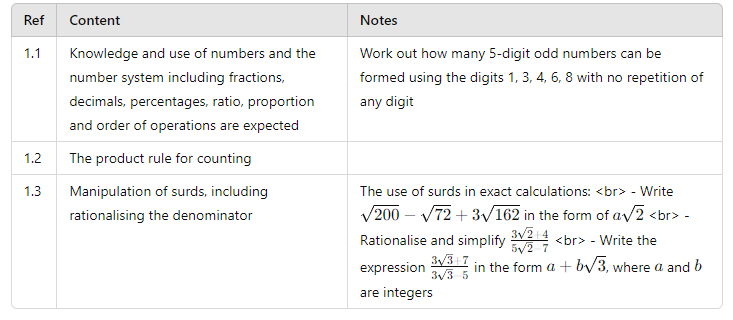
In Further Maths GCSE, you learn more complex math. The section on Numbers looks at three big ideas getting to know different ways to count, using a special rule to figure out how many unique odd numbers with five digits can be made from specific numbers and working with surds. This includes making the bottom part of a fraction (denominator) simpler and doing precise calculations.
Number Topic Chart
Algebra
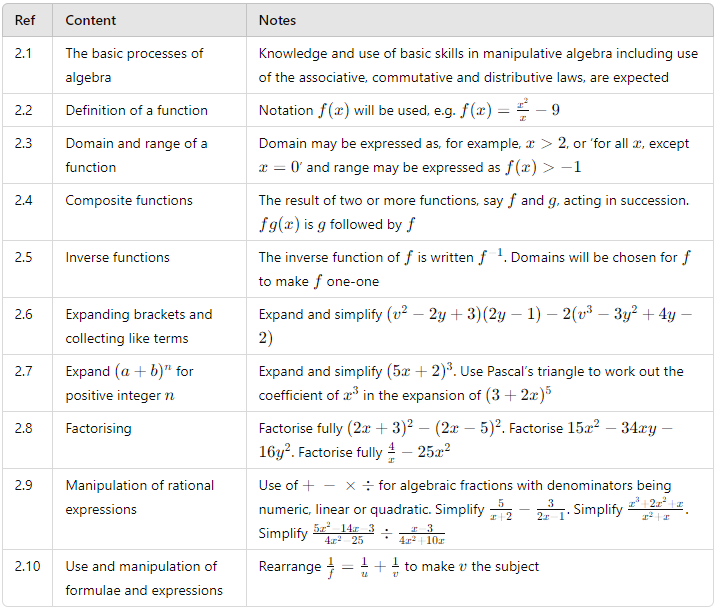
Algebra is a key part of Further Maths GCSE. It teaches you the basics of algebra, like what functions are, along with composite and inverse functions, plus how to figure out their domain and range. It also shows you how to grow and simplify phrases, using tools like Pascal’s triangle and how to break down complex expressions. You can also learn how to work with rational expressions and how to use formulas and expressions. This covers many important techniques and principles you need to know well for algebra.
Algebra Topic Chart
Calculus
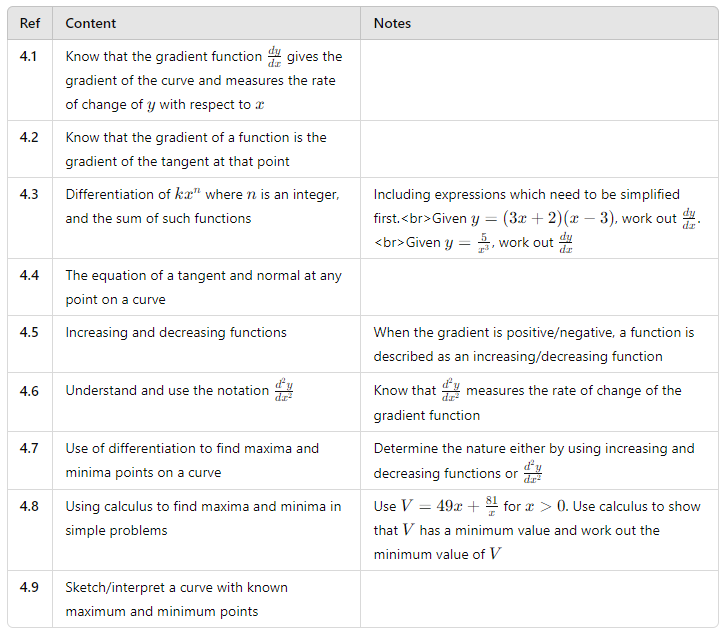
The concept about calculus talks about some key ideas in Further Maths GCSE, a type of maths that’s really important for those studying More Maths in high school. It’s mostly about differentiation, which helps figure out how fast things change. It also talks about how this connects to the slope of a line touching a curve at any point. The main points are about working with power functions in differentiation, how to write down second derivatives, and finding the highest and lowest points using differentiation. Additionally, it shows how to apply these ideas to solve easy problems and understand curves that have clear high and low points.
Calculus Topic Chart
AQA Past Papers – Further Maths
If you’re getting ready for your GCSEs or A-Levels, using AQA Past Papers can really help. These old exam papers are super useful for your study plan. When you practice with them, you understand the kind of questions that come up, get better at managing your time, and figure out which subjects you need to spend more time on. Using AQA Past Papers is an effective way to maximise your GCSE potential.
Here’s how you can use most of the AQA Past Papers
Find the Papers – Go to the AQA official website or look on reliable education sites to get the past papers you need for your studies.
Practice with a Timer – Practice for tests like you’re really taking them by using a timer. This way, you learn to use your time better when it’s the real deal.
Review and Learn – Once you finish a paper, look over your answers carefully. Find out which ones were incorrect and go over those subjects again.
Progression and Career Pathways
The Further Maths GCSE helps you move on to more advanced studies and a variety of job options. It lays a great groundwork for A-Level Maths and Further Maths. It lays a great groundwork for A Level Maths and Further Maths A Level, which builds upon these foundational concepts and explores even more advanced mathematical topics. For ambitious students, it’s worth noting that Further Maths is often listed among the hardest A Level subjects, but the strong foundation from GCSE Further Maths can make this challenge much more manageable. It’s also really useful for studying science, technology and business where you need deeper maths skills.
Enrolment and Further Information
Want to get better at maths? Signing up for the Further Maths GCSE is easy. Just talk to the guidance counsellor at your school or check out the official website of CCEA to learn how to begin.

Conclusion
Further Maths GCSE is a strong choice for students who already feel confident in Maths and want to take on more advanced topics such as algebra, calculus, mechanics and statistics. It can also provide useful preparation for A-Level Maths and Further Maths.
To succeed, students should build a strong understanding of each topic, practise regularly and use past papers to improve both accuracy and exam technique. More challenging areas may take time, so reviewing mistakes and revisiting weaker topics is especially important.
If you need extra support, GCSE Further Maths tutors can provide personalised explanations, targeted practice and guidance with more advanced topics, helping you prepare with greater confidence.
FAQs
What Is Further Maths GCSE?
Further Maths GCSE is an advanced Maths qualification designed for students who are already confident with standard GCSE Maths. It introduces more challenging topics such as advanced algebra, functions, matrices and introductory calculus, helping students prepare for A-Level Maths and Further Maths.
Is Further Maths GCSE Hard?
Yes, Further Maths GCSE is more challenging than standard GCSE Maths because it covers more advanced concepts and requires stronger problem-solving skills. However, students who are confident with algebra and enjoy Maths can manage the course well with regular practice and careful revision.
Is Further Maths GCSE Worth Taking?
Further Maths GCSE can be worth taking for students who enjoy Maths and are considering A-Level Maths, Further Maths, Physics, Engineering or other quantitative subjects. It can strengthen mathematical reasoning, introduce more advanced topics early and make the transition to post-16 Maths easier.
What Topics Are Covered in Further Maths GCSE?
Further Maths GCSE usually includes advanced algebra, functions, graphs, geometry, trigonometry and introductory calculus. Some specifications may also include matrices and other higher-level topics. The exact content depends on the qualification and exam board, so students should always check their course specification.
Does Further Maths GCSE Help With A-Level Maths?
Yes, Further Maths GCSE can make the transition to A-Level Maths easier because students meet some advanced concepts before starting sixth form. It can also strengthen algebraic manipulation, problem-solving and mathematical reasoning, which are important throughout A-Level Maths.